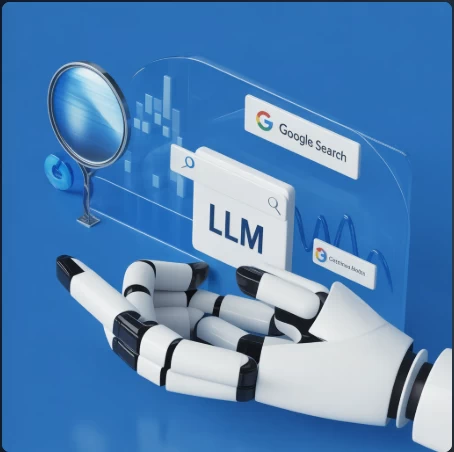
Search has entered its most significant transformation since the launch of Google. For over two decades, users relied on keyword-driven results pages—ten blue links, ads at the top, and featured snippets competing for attention. Today, LLM search is changing that model entirely.
Large Language Models now interpret intent, summarize answers, and recommend solutions in a conversational format. Instead of clicking through multiple websites, users increasingly expect direct, synthesized answers.
This shift is not theoretical. It is already influencing how visibility, authority, and trust are earned online.
The critical question for brands is no longer “How do I rank?”
It is now “How do I get cited, trusted, and referenced by LLM-powered search systems?”

LLM search refers to search systems powered by Large Language Models that retrieve, interpret, and generate answers using natural language understanding rather than relying solely on keyword matching.
Unlike traditional search engines that index pages and rank them algorithmically, LLM-based search engines:
Understand context and intent
Combine information from multiple sources
Deliver direct answers instead of lists
Reduce dependency on exact-match keywords
In simple terms, LLM search behaves more like a research assistant than a directory.
Many users searching for “LLM search meaning” want a clear explanation:
LLM search uses artificial intelligence models trained on massive text data to answer questions, summarize content, and guide decisions in real time.
This approach enables:
Conversational queries
Follow-up questions
Personalized answers
Context retention across sessions

Relies on indexed pages
Ranks content using backlinks and on-page SEO
Requires users to click multiple results
Optimized primarily for keywords
Understands user intent
Produces single, comprehensive answers
Reduces clicks to external websites
Optimized for authority and clarity
This is why many marketers now ask:
“Will LLM replace search?”
The short answer: No—but it is reshaping it permanently.
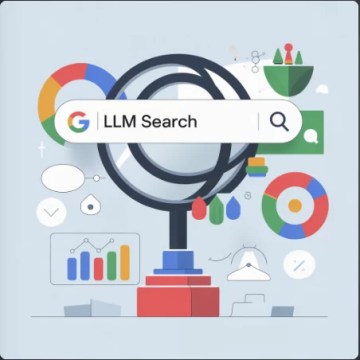
Yes. LLMs are already being used in search-like environments through:
AI-powered assistants
Knowledge engines
Enterprise internal search systems
Developer tools using LLM search APIs
LLM web search integrates:
Traditional indexing
Semantic understanding
Real-time data retrieval
This hybrid approach is becoming the standard.

An LLM search engine combines:
Crawled web data
Vector embeddings (semantic meaning)
Natural language generation
Instead of ranking pages, it reasons over content.
Common capabilities include:
Summarized answers
Source attribution
Follow-up questions
Contextual memory
This is why keywords like “best LLM search engine” and “LLM based search engine” are trending rapidly.
SEO is no longer just about rankings—it is about inclusion.
If your brand content is:
Poorly structured
Thin or generic
Lacking authority signals
…it may never be referenced by LLM systems, even if it ranks well today.
Clear topical authority
Expert-written content
Structured data and FAQs
Entity consistency
Trust signals
LLM search results are created through:
Query interpretation
Semantic retrieval
Source comparison
Answer synthesis
This means one weak paragraph can disqualify an entire page.
Brands must now write content that:
Answers questions fully
Avoids fluff
Demonstrates expertise
.
LLM semantic search understands meaning, not words.
Example:
Traditional query:
“best llm search engine”
Semantic understanding:
Performance
Use cases
Accuracy
Real-world adoption
Trustworthiness
Content that fails to cover semantic depth will be ignored.
Google is actively integrating LLMs into its ecosystem:
AI Overviews
Generative summaries
Conversational follow-ups
This reduces organic clicks but increases brand exposure inside AI answers.
Visibility is shifting from:
Page position → Answer inclusion
No—but it will replace shallow search behavior.
Users still need:
Verification
Comparison
Transactional pages
However, informational queries are increasingly handled inside LLM responses.
Brands must shift from:
Keyword stuffing
Generic blogs
To:
Authoritative resources
Structured knowledge hubs
Expert-driven insights
SEO is evolving into Search Experience Optimization.
Answer real questions clearly and directly.
LLMs rely on structure to extract meaning.
PAA-aligned FAQs are critical.
Use data, examples, and real insights.
LLMs can detect repetition and low value.
LLM search APIs enable:
Internal knowledge bases
Custom enterprise search
AI-powered SaaS platforms
This is why searches for “llm search api” and “llm web search api” are accelerating.
Search agents:
Execute tasks
Compare options
Recommend decisions
Brands not optimized for LLM visibility risk complete invisibility in agent-driven ecosystems.
Expect:
Fewer clicks
More zero-click answers
Higher trust barriers
Authority-based visibility
The winners will be:
Brands with deep content
Verified expertise
Consistent publishing
LLM search is not a trend—it is a structural shift.
Brands that adapt early will:
Own visibility
Build trust
Dominate AI-driven discovery
Those who wait will compete only for what remains.

SEO Growth Consultant for eCommerce & Brands Building Search Ecosystems That Drive Compounding Organic Revenue (UK • UAE • USA)
Price Based Country test mode enabled for testing United Kingdom (UK). You should do tests on private browsing mode. Browse in private with Firefox, Chrome and Safari
Subscribe now to keep reading and get access to the full archive.