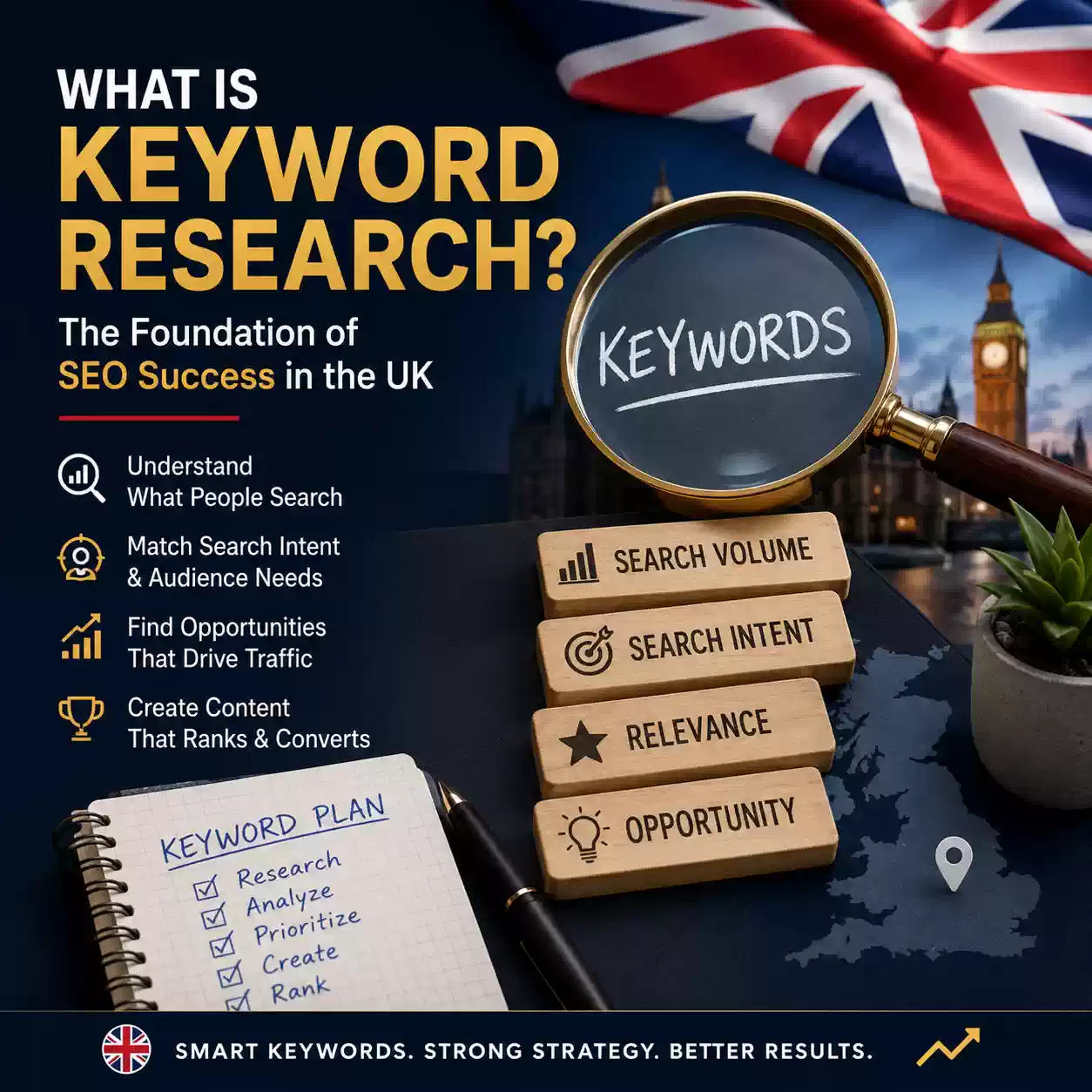
What is keyword research in SEO, showing search volume, search intent, relevance and opportunity for UK businesses.How to Do Keyword Research for SEO: UK Keyword Strategy Guide

Knowing how to do keyword research for SEO is one of the foundations of an effective search strategy. Keyword research helps you understand what people search for, how they phrase their questions, what they actually want to achieve and which topics deserve a dedicated page on your website.

For UK businesses, however, keyword research should go further than simply finding phrases with high monthly search volumes. Search behaviour varies by country, region, terminology, commercial intent and even spelling. A keyword that performs well internationally may not represent the way British customers search.

Modern keyword research must also account for a changing Google search environment that includes traditional organic results, People Also Ask results, local listings, shopping results, videos, AI Overviews and AI Mode. Google states that the same fundamental SEO practices used for conventional Search remain relevant to its generative AI features.

This guide explains how to research, assess, cluster and use SEO keywords for a UK audience while creating content that remains understandable to search engines, users and AI-powered discovery systems.

What is keyword research in SEO, showing search volume, search intent, relevance and opportunity for UK businesses.What Is Keyword Research in SEO?

Keyword research is the process of identifying and analysing the words, phrases and questions people use when searching for information, products, services or businesses online.

An SEO keyword is therefore not simply a phrase that should be repeated throughout a page. It represents a search need.

For example:

  • SEO is extremely broad.
  • SEO services demonstrates greater commercial relevance.
  • SEO services UK introduces geographical intent.
  • SEO consultant Manchester has clear local and commercial intent.
  • How to do keyword research for SEO indicates informational intent.
  • Best keyword research tools suggests comparison or commercial-investigation intent.

The objective is to understand the relationship between the query, the user and the page that should satisfy that query.

Google itself describes SEO as the process of improving a site for search engines and recommends creating useful, understandable content rather than repeatedly inserting keywords.
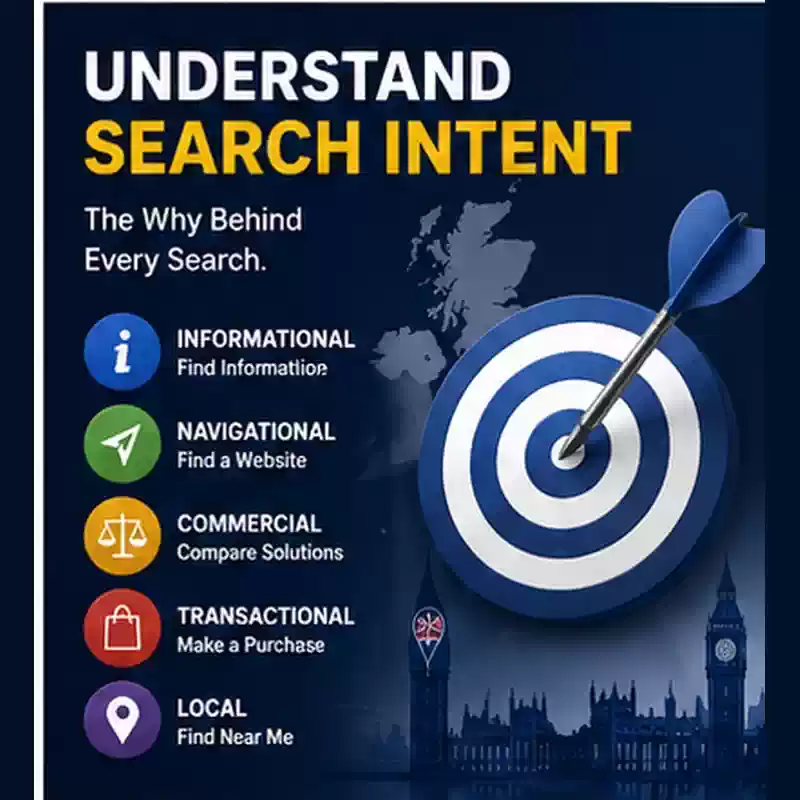
Understanding search intent in SEO, including informational, commercial, transactional and navigational intent for keyword strategy.Keyword research is really intent research

Search volume tells you how often something may be searched.

Search intent tells you why it is being searched.

That distinction should influence almost every decision you make during keyword research.

A keyword with 500 relevant searches from potential UK customers may be considerably more commercially valuable than a generic phrase attracting 10,000 searches from people who are unlikely to need your product or service.

Why Keyword Research Matters for SEO in the UK

Effective keyword research connects your website with the language your target audience actually uses.

For UK companies, this can involve:

  • British terminology
  • UK spelling
  • Regional search behaviour
  • City and county modifiers
  • Product terminology
  • Service terminology
  • Local commercial intent
  • UK-specific legislation or regulations
  • Pricing queries containing pounds or UK references

Consider a company providing search marketing services.

A broad keyword such as:

SEO

provides very little information about the searcher.

Compare it with:

SEO company UK

or:

local SEO services UK

or:

SEO consultant London

The subject remains SEO, but the intent becomes progressively clearer.

This is why successful keyword strategies should not be constructed purely around search volume.

They should consider:

relevance + intent + business value + competition + topical fit.

Types of SEO keywords including short-tail, long-tail, informational, commercial and transactional keywords.What Are the Main Types of Keywords?

Understanding the different types of keywords makes it easier to organise your research.

Short-tail keywords

These are broad phrases, normally one or two words.

Examples:

  • SEO
  • keyword research
  • digital marketing

They often describe large topics but may have ambiguous intent.

Long-tail keywords are more specific searches.

Examples:

  • how to do keyword research for SEO
  • best free keyword research tools UK
  • how to find SEO keywords for a website
  • keyword research for small businesses UK

Long-tail searches can be particularly useful because the user’s problem or objective is often clearer.

The user wants information.

Examples:

  • what is SEO
  • how does SEO work
  • how is keyword research done
  • what is search intent

The user is comparing potential solutions.

Examples:

  • best keyword research tools
  • best SEO agency UK
  • Semrush vs Ahrefs
  • best SEO consultant London

The searcher is closer to taking an action.

Examples:

  • hire SEO consultant
  • buy SEO audit
  • SEO services UK
  • keyword research service

The user already knows which website, company or platform they want.

Examples:

  • Google Keyword Planner
  • Google Search Console
  • Semrush login

These combine a service, business or product with geographical intent.

Examples:

  • SEO London
  • SEO consultant Manchester
  • local SEO Birmingham
  • digital marketing agency Leeds

A branded search contains a company or product name.

A non-branded search focuses on the subject or requirement rather than a specific supplier.

Both matter, but non-branded queries are particularly important when trying to reach people who do not already know your business.

Understanding search intent in SEO including informational, navigational, commercial, transactional and local search intent.Search Intent: The Foundation of Good Keyword Research

Before targeting a keyword, search it.

This simple step is frequently overlooked.

Google the query from the UK and study what currently ranks.

Ask:

  • Are the results blog articles?
  • Service pages?
  • Product pages?
  • Category pages?
  • Videos?
  • Forums?
  • Local businesses?
  • Comparison guides?
  • AI-generated answers?
  • People Also Ask results?

The existing SERP provides valuable evidence about how the query is currently being interpreted.

For example, if the first page for a keyword contains almost entirely educational guides, attempting to rank a highly promotional service page may create an intent mismatch.

Similarly, if Google predominantly returns local companies and Maps results, the query probably has strong local intent.

The goal is not to copy competitors.

The goal is to understand the content format Google currently considers useful for the search and then determine whether you can provide something more useful, expert or complete.
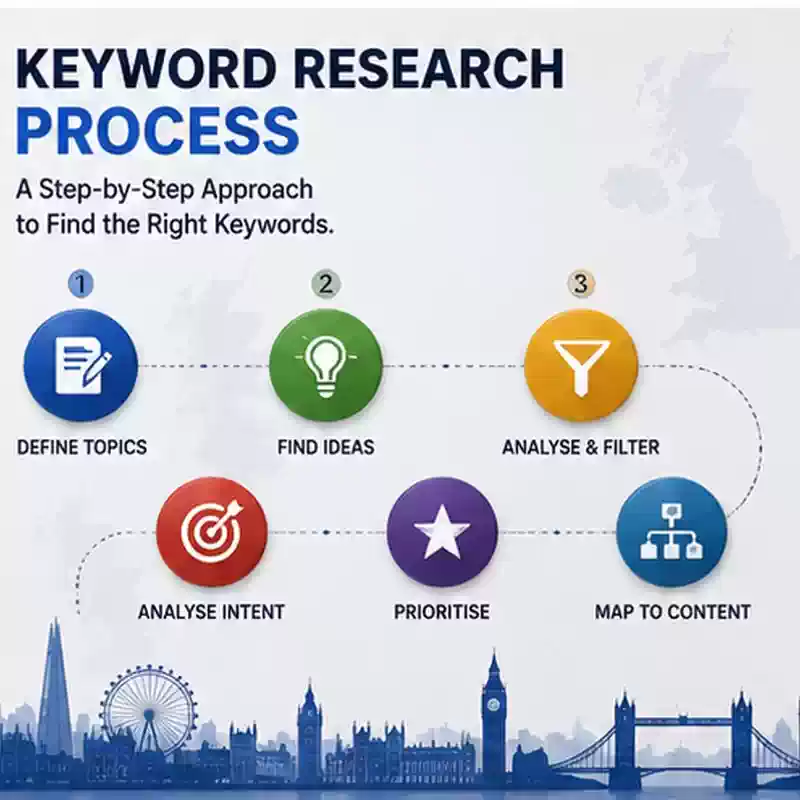
Keyword research process covering topic definition, keyword discovery, analysis, search intent, prioritisation and content mapping.How to Do Keyword Research for SEO Step by Step

A reliable UK keyword research process can be divided into ten stages.

Define Your Core Business Topics

Do not start by opening a keyword tool.

Start with the business.

Write down:

  • your main products
  • your services
  • your customer groups
  • problems customers ask you to solve
  • industries you serve
  • geographical areas
  • common sales questions
  • customer objections
  • terminology customers use

For an SEO consultancy, the initial topic list might contain:

  • technical SEO
  • local SEO
  • ecommerce SEO
  • keyword research
  • SEO audits
  • link building
  • Google Business Profile
  • content optimisation
  • SEO consultancy

These are topics rather than final keywords.

They become your seed topics.

Now convert each broad topic into searches a customer might actually make.

For keyword research, examples could include:

  • keyword research
  • SEO keyword research
  • how to do keyword research
  • keyword research tools
  • keyword research UK
  • Google Keyword Planner
  • how to find keywords for SEO
  • types of SEO keywords

Avoid trying to decide immediately which phrase is best.

At this stage the objective is discovery.

Google Keyword Planner remains useful for discovering keyword ideas, estimated demand and related terminology.

For UK research, make sure the location is configured for the United Kingdom rather than accepting global targeting by default. Keyword Planner allows geographical targeting by countries, regions and cities.

Enter several closely related seed keywords rather than relying on a single phrase.

Then analyse:

  • related keywords
  • estimated search demand
  • competition
  • geographical relevance
  • commercial variations
  • wording differences

Remember that Keyword Planner was designed primarily for Google Ads, so its metrics should inform SEO decisions rather than dictate them.

Some of the most valuable keyword intelligence is available directly in the SERP.

Look at:

Google autocomplete

Begin typing your target keyword and review the suggested continuations.

People Also Ask

For this topic, relevant questions include:

  • How can I conduct keyword research for SEO?
  • What is the 80/20 rule in SEO?
  • Can I use ChatGPT for keyword research?
  • How is keyword research done?
  • What are the best tools for keyword research in SEO?
  • How many keywords per 1,000 words?
  • What are some free tools for keyword research?
  • What are the top SEO strategies?

These questions can reveal supporting subtopics and make excellent H2, H3 or FAQ opportunities where they genuinely contribute to the article.

People Also Search For and related searches

Related searches can expose adjacent topics such as:

  • Google Keyword Planner
  • what is SEO
  • what is SEO and how it works
  • SEO London

But use judgement.

Not every suggestion belongs on your page.

For example, a query such as SEO Civil Service salary represents a completely different search requirement. Adding it merely because Google displays it somewhere around the SERP would weaken topical focus.

Keyword research is therefore partly a process of elimination.

If the website already receives organic impressions, Google Search Console should be one of the first sources you examine.

Look for pages receiving impressions for keywords positioned roughly outside your strongest rankings.

You may discover:

  • queries generating impressions but few clicks
  • pages ranking for unexpected terms
  • long-tail keywords
  • emerging queries
  • declining keywords
  • different queries leading to the same page

Google recommends Search Console as its first-party source for understanding a site’s actual Google Search performance and cautions that third-party SEO platforms do not have access to Google’s internal ranking data.

That does not make Semrush, Ahrefs or similar platforms unnecessary. They are extremely useful for research and competitive analysis.

It means their metrics should be treated as third-party estimates, not Google ranking scores.

Next, investigate websites already performing well for your target subject.

Ask:

  • Which topics do they cover?
  • Which pages attract organic visibility?
  • Which questions appear repeatedly?
  • Which topics have they ignored?
  • Are their articles outdated?
  • Are examples generic?
  • Is there UK-specific information missing?
  • Can you provide original experience or data?

The objective is not simply to reproduce every keyword competitors use.

Look for information gain.

If ten ranking articles all explain exactly the same five steps, an eleventh article repeating them provides limited additional value.

Instead, consider adding:

  • UK-specific examples
  • screenshots
  • practical workflows
  • original observations
  • templates
  • comparisons
  • case studies
  • real Search Console examples
  • first-hand professional experience

Google’s people-first content guidance emphasises useful, reliable content created primarily to help users rather than pages produced mainly to attract search traffic.

Do not judge keywords by volume alone.

A practical SEO keyword evaluation framework is:

FactorQuestion
RelevanceDoes this relate directly to the business or topic?
Search IntentWhat does the user actually want?
Search DemandIs there evidence people search for it?
Business ValueCould the query eventually contribute to a commercial objective?
CompetitionWhat quality of pages currently rank?
Authority RequirementCan your website realistically compete?
TrendIs demand growing, stable or declining?
Content FitDoes it deserve its own page or belong within another page?
UK RelevanceDoes the terminology and SERP match the UK market?

This produces much better decisions than simply selecting the keyword with the largest search-volume number.

Closely related keywords should often be grouped together rather than assigned separate pages.

For this article, one cluster might contain:

Primary keyword:
how to do keyword research for SEO

Supporting terms:

  • SEO keyword research
  • SEO keyword
  • keyword research UK
  • types of keywords
  • search intent
  • Google Keyword Planner
  • keyword research tools
  • long-tail keywords
  • ChatGPT keyword research

These expressions can be addressed naturally within one comprehensive resource.

Creating separate near-identical articles for every tiny keyword variation risks creating weak, overlapping content.

Think in terms of topics and intent, not one-page-per-keyword.

Once keywords are clustered, assign each cluster to a destination URL.

For example:

Informational

how to do keyword research for SEO
→ Educational guide

Commercial

SEO services UK
→ Main SEO service page

Local commercial

SEO London
→ Genuine London service/location page if the business actually serves that market

Educational

what is SEO
→ Foundational SEO guide

Local SEO

local SEO services UK
→ Dedicated local SEO page

This is called keyword mapping.

A keyword map helps prevent multiple pages from competing for the same search intent and gives your site a clearer topical architecture.

Keyword research should end where it began: Google.

Search the final phrase again and examine the page-one results.

Check:

  • dominant intent
  • page types
  • content depth
  • freshness
  • strong domains
  • weak results
  • PAA questions
  • video presence
  • local packs
  • images
  • AI Overviews
  • forums or community results

Then ask the most important question:

Can we create a genuinely better page for this searcher?

If the answer is no, reconsider the keyword.

Can You Use ChatGPT for Keyword Research?

Yes. ChatGPT and other AI tools can be extremely useful during keyword research, but they should be treated as research assistants rather than sources of verified Google search-volume data.

Useful AI applications include:

  • Generating seed keyword ideas
  • Categorising keyword lists
  • Identifying likely search intent
  • Clustering related phrases
  • Finding topical relationships
  • Generating potential questions
  • Developing content outlines
  • Identifying missing subtopics
  • Transforming raw research into a keyword map

For example, you could provide an exported Keyword Planner or Search Console dataset and ask AI to group queries by informational, commercial, transactional and local intent.

What you should not do is ask an AI model to invent monthly search volumes and then treat those figures as verified data.

SEO keyword research workflow combining AI ideation, first-party Google data, third-party research and manual SERP analysis.The strongest workflow combines:

AI ideation + first-party Google data + third-party research + manual SERP analysis.

Google also distinguishes between sensible use of generative AI and producing large volumes of low-value pages primarily to manipulate rankings. Scaled AI content without additional user value can conflict with Google’s spam policies.
How Keyword Research Changes for AI Overviews and LLM Search

Traditional keyword research remains important, but modern content needs to communicate concepts clearly enough for both people and machine systems to understand.

Google’s current guidance is particularly important here: SEO remains relevant to its generative AI experiences because AI Overviews and AI Mode are grounded in Google’s existing Search systems and index. Google specifically advises publishers to prioritise unique, useful content and established SEO fundamentals rather than chasing separate AEO or GEO tricks.

For this reason, AI-aware keyword research should increasingly focus on topics, questions, entities and relationships, rather than repeating exact-match keywords.

Use answer-first passages

Immediately after an important question, provide a concise answer.

For example:

What is search intent?

Search intent is the underlying objective behind a search query, such as learning something, comparing options, visiting a specific website or completing a purchase.

Then expand on the answer.

This structure is easy for readers to scan and clearly establishes the subject being discussed.

Define important entities

Avoid vague references.

Instead of repeatedly saying:

“this tool”

say:

“Google Keyword Planner”

when clarity matters.

Likewise, establish relationships clearly:

Google Search Console provides first-party performance data from Google Search.

Clear entity relationships improve comprehension for readers and automated systems.

Provide original value

AI systems can summarise generic definitions easily.

Your competitive advantage increasingly comes from information that is difficult to commoditise:

  • personal experience
  • professional expertise
  • original data
  • experiments
  • examples
  • processes
  • comparisons
  • screenshots
  • case studies
  • expert judgement

Google’s 2026 generative-AI guidance specifically recommends creating non-commodity content that adds unique value beyond widely available information.

Do not create content merely for an LLM

There is no requirement to rewrite every paragraph into artificial “AI chunks”.

Google specifically states that publishers do not need special AI markup or llms.txt files to appear in Google Search’s generative AI experiences. In June 2026, Google further clarified that llms.txt has neither a positive nor negative effect on Google Search visibility or rankings.

Build an excellent page first.

Make it structured, explicit and easy to understand second.

Do not sacrifice natural writing for imagined LLM optimisation rules.

How Many Keywords Should You Use Per 1,000 Words?

There is no correct number of keywords per 1,000 words.

A 1,000-word article does not need ten, twenty or thirty repetitions of its focus keyword.

Use the main keyphrase where it naturally helps establish the topic, including appropriate locations such as:

  • SEO title
  • H1
  • Introduction
  • Relevant heading
  • Body content
  • Image alt text when genuinely descriptive
  • Internal-link context where appropriate

Then use natural semantic language to explain the subject thoroughly.

Google explicitly warns against keyword stuffing and excessive repetition.

If the page comprehensively answers the query, variations will normally appear naturally.

What Is the 80/20 Rule in SEO?

The 80/20 principle in SEO is best treated as a prioritisation concept rather than a Google rule.

In keyword research, it means recognising that a relatively small group of pages or queries may generate a disproportionately large share of meaningful organic traffic, enquiries or revenue.

Rather than spreading resources evenly across hundreds of low-value keywords, identify the subjects that combine:

  • Strong relevance
  • Realistic ranking potential
  • Useful search demand
  • Commercial importance

Then invest more heavily in those opportunities.

The exact ratio will vary by website.

The principle is simply to concentrate effort where it can produce meaningful results.

Essential keyword research tools for UK SEO including Google Keyword Planner, Search Console, Semrush, Ahrefs and ChatGPT.What Are the Best Tools for Keyword Research?

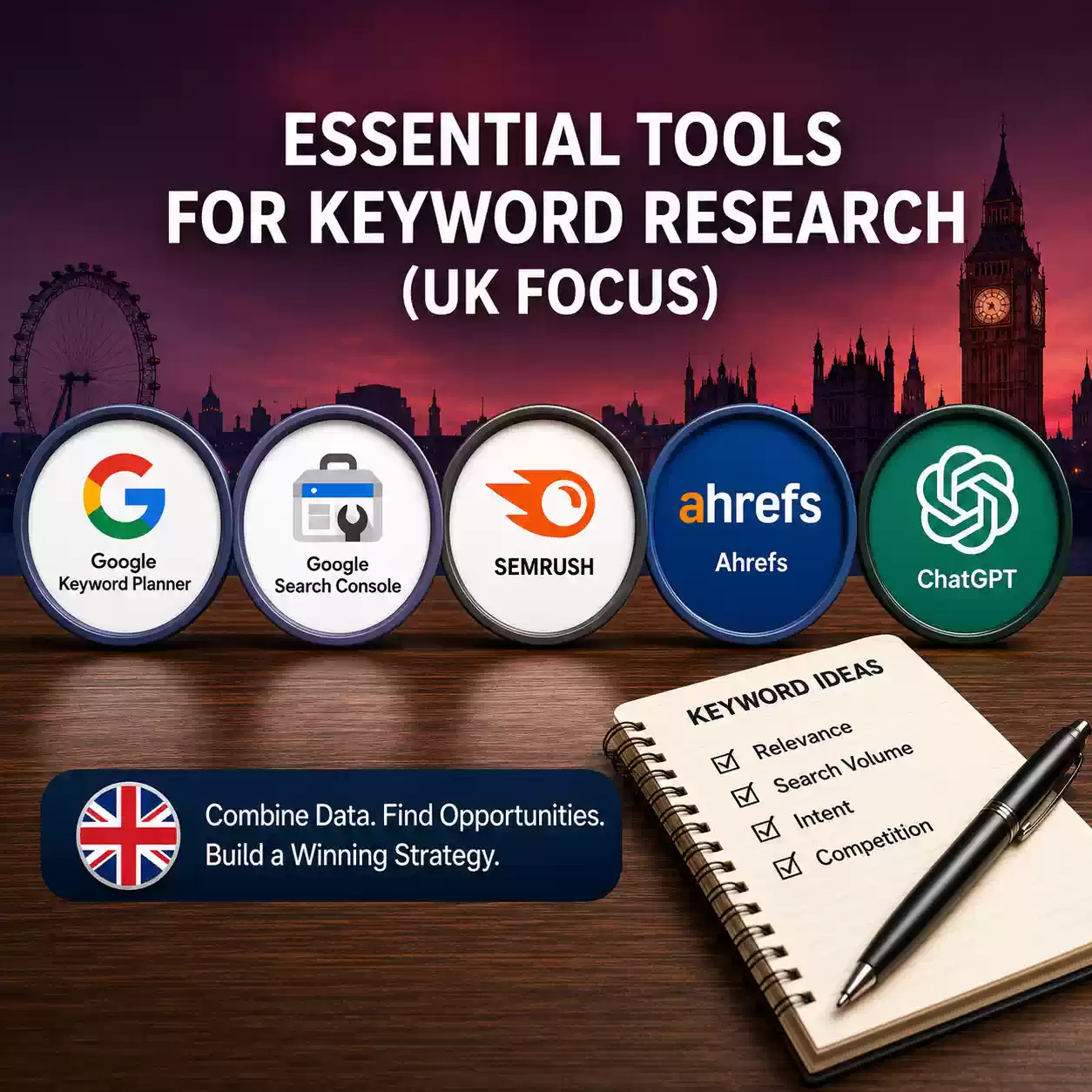
There is no single best keyword research tool because different tools answer different questions. Useful tools include:
Google Search Console

Best for understanding queries for which your existing website already receives impressions and clicks.

Useful for keyword discovery, geographical targeting and demand estimates.

Useful for comparing relative interest and identifying seasonality or changes in demand.

Useful for analysing intent, competitors, People Also Ask questions and related searches.

Useful for competitor research, keyword discovery, ranking analysis and content-gap analysis.

Useful for competitor keywords, backlinks, ranking research and content opportunities.

Useful for brainstorming, categorisation, clustering, query expansion and converting raw research into a structured strategy.

Use multiple sources rather than allowing one proprietary metric to make the decision for you. Google notes that third-party SEO tools do not have access to its internal ranking data and cannot guarantee search performance.

Highly regarded by developers for complex software architecture and maintaining deep context across large codebases.

Sounds more human and less robotic right out of the box. It avoids typical AI buzzwords and emulates a natural writing rhythm.

AI assistant from Google — Create AI images, brainstorm ideas, and verify responses with Google Search integration. Our biggest upgrade. Next generation intelligence: free, fast, and unlimited.

Common Keyword Research Mistakes

Choosing keywords purely by search volume

High volume does not automatically mean high value.

This can produce overlapping, thin or repetitive pages.

A keyword is unlikely to perform well if the content format does not satisfy the user’s objective.

Competitors may be targeting irrelevant or unprofitable queries themselves.

Global data can hide meaningful differences in British search behaviour.

Related queries should be evaluated for relevance rather than inserted mechanically.

Third-party difficulty metrics are useful comparative indicators, not direct measurements of Google’s ranking systems.

Google’s spam policies explicitly identify unnatural keyword stuffing as a practice to avoid.

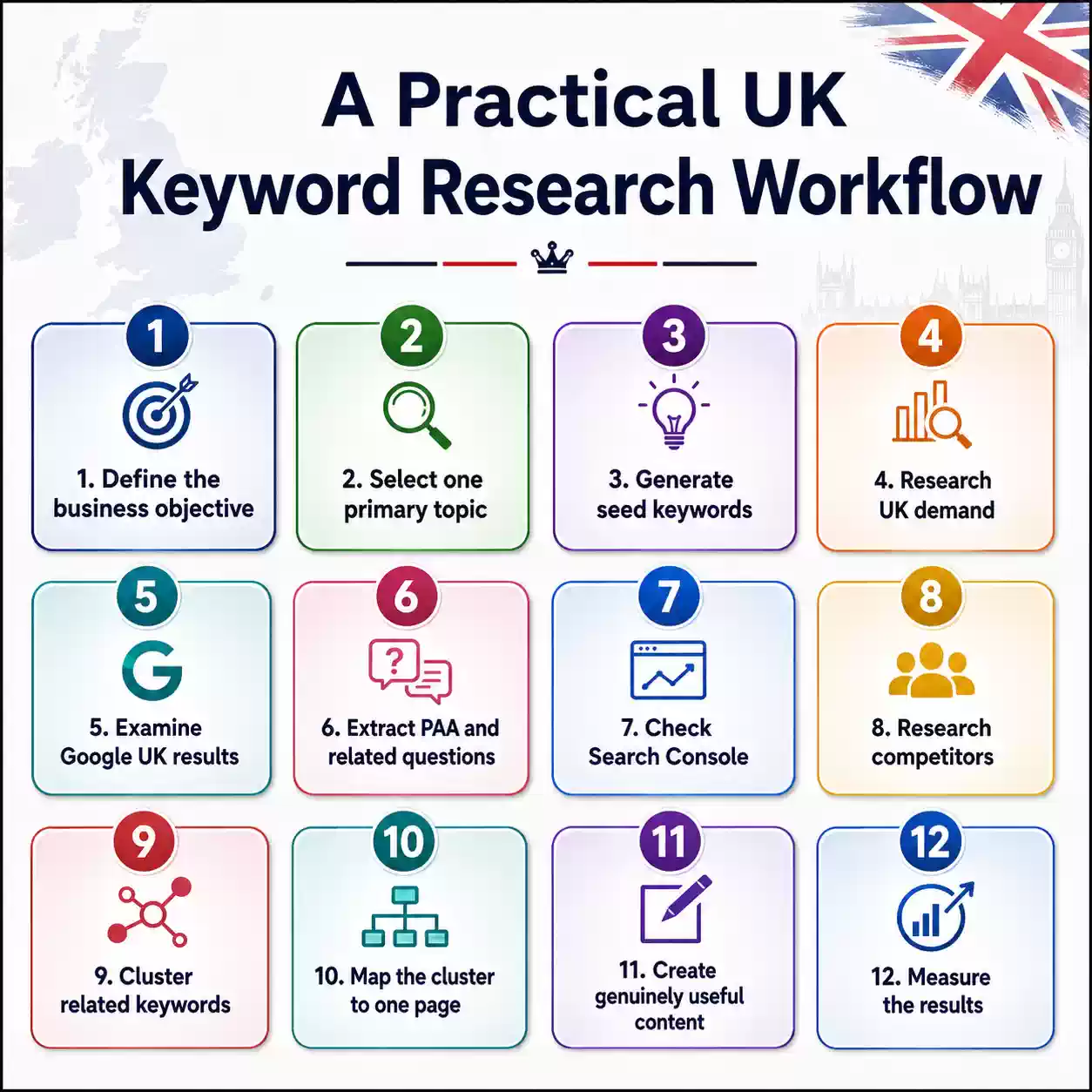
Practical UK keyword research workflow showing 12 SEO steps from defining business objectives and seed keywords to search intent, keyword clustering, content creation and measuring results.A Practical UK Keyword Research Workflow

For a new article or landing page, use this workflow:

Define the business objective

What should the page accomplish?

Avoid starting with dozens of unrelated ideas.

Use customer language and business terminology.

Configure Keyword Planner and other tools for the United Kingdom.

Validate search intent manually.

Use relevant questions as supporting content opportunities.

Look for existing impressions and near-ranking queries.

Identify content gaps rather than simply copying headings.

Group phrases sharing the same underlying intent.

Prevent unnecessary overlap.

Add expertise, examples and original information.

  • Track impressions, clicks, rankings, engagement and conversions.
  • Keyword research is not finished when the article is published.
  • Search behaviour changes.
  • Competitors publish new material.
  • Your website gains authority.
  • New queries appear in Search Console.
  • Review important pages periodically and update them when the underlying topic or search landscape changes.

Keyword Research for SEO: Final Takeaway

Learning how to do keyword research for SEO is less about finding the largest keyword list and more about understanding the relationship between search behaviour, intent, content and business objectives.

For a UK SEO strategy, begin with your audience and core services, collect relevant keyword ideas, use UK-specific data, study the live Google results and organise related queries into logical topic clusters.

Then create the page that best satisfies the searcher’s requirement.

Use tools such as Google Keyword Planner and Search Console for data, professional SEO platforms for competitive intelligence and AI tools such as ChatGPT for research, organisation and ideation.

Most importantly, avoid designing content around arbitrary keyword densities or supposed AI-search shortcuts.

Google’s current guidance is consistent on this point: strong technical foundations, useful people-first content and genuine expertise remain central to visibility in both traditional Search and Google’s generative AI experiences.

Keyword research should therefore answer three questions:

  1. What is the user searching for?
  2. Why are they searching for it?
  3. Can we create the best possible resource for that requirement?

When those three questions are answered correctly, keywords stop being isolated phrases and become the foundation of a coherent SEO strategy.

FJK SEO BANNER IMAGE -SEO UKHow FJK SEO UK Can Help

FJK SEO UK supports businesses that want organic search to become a measurable commercial channel rather than simply another marketing activity. The approach combines:
Technical SEO

Crawling, indexation, site architecture, internal linking and performance.

Keyword research, search-intent mapping and competitive analysis.

Commercial landing pages, expert-led content and topical development.

Google Business Profile optimisation, local search strategy and geographic visibility.

Building technically accessible, well-structured and genuinely useful content capable of competing across traditional and generative search experiences.

Category architecture, product optimisation, structured product information and commercial search visibility.

The goal is not simply to obtain rankings.

It is to connect rankings, visibility and content with qualified enquiries, customers and revenue.

Need a stronger organic search strategy for your UK business? Contact FJK SEO UK for an SEO audit and practical growth plan.

Frequently Asked Questions About Keyword Research

How can I conduct keyword research for SEO?

Start by identifying your core topics and customer questions. Generate seed keywords, research them using tools such as Google Keyword Planner and Search Console, examine Google results to determine search intent, analyse competitors, group related terms into clusters and map each cluster to the most appropriate page.

Keyword research normally involves discovering search terms, checking their relevance and demand, understanding search intent, analysing competition, grouping similar queries and deciding which page should target each topic.

Yes. ChatGPT is useful for brainstorming keywords, identifying questions, categorising search intent and clustering large keyword lists. However, verify search demand and performance using sources such as Google Keyword Planner, Google Search Console and professional SEO platforms rather than relying on AI-generated search-volume estimates.

Useful tools include Google Keyword Planner, Google Search Console, Google Trends, Google Search, Semrush, Ahrefs and AI tools such as ChatGPT. The best combination depends on whether you need first-party performance data, competitive analysis, search-volume estimates or content ideation.

Google Search, Google autocomplete, People Also Ask, related searches, Google Trends, Google Search Console and Google Keyword Planner can provide substantial keyword intelligence without a paid SEO subscription.

There is no fixed keyword quota. Focus on comprehensively satisfying the search intent and use your main keyword and relevant variations naturally. Artificially repeating keywords to reach a predetermined density can create keyword stuffing.

The 80/20 concept suggests prioritising the smaller group of pages, keywords and activities capable of generating the greatest proportion of meaningful SEO results. It is a strategic prioritisation principle, not an official Google ranking rule.

Five core areas are: strong keyword and intent research, high-quality helpful content, sound technical SEO, authoritative internal and external links, and continuous performance measurement using tools such as Google Search Console.

Share this:

Like this:

Like Loading…

Discover more from FJK SUBLI

Subscribe now to keep reading and get access to the full archive.

Continue reading