Why organic seo is winning in the UK - FJK SEOWhy Organic SEO Is Winning in the UK as Ad Fatigue Increases

For UK businesses competing for online attention, paid advertising remains powerful—but it is no longer sensible to build an entire digital growth strategy around buying every visit. Organic SEO UK strategies are becoming increasingly important because they create visibility precisely when potential customers are researching, comparing and preparing to make a decision.

A modern organic SEO UK strategy also goes far beyond ranking a page for a handful of keywords. Search now includes conventional Google results, local results, Google Maps, images, video, shopping features, AI Overviews and AI Mode. Businesses therefore need an organic presence that can be understood, trusted and surfaced across several search experiences.

The important point is not that advertising has stopped working.

Quite the opposite.

The UK’s digital advertising market reached £40.5 billion in 2025, an increase of 10% year-on-year.

That level of investment demonstrates how valuable digital advertising remains—but it also illustrates the scale of competition for consumers’ attention.

Organic search occupies a different position.

Instead of interrupting someone and attempting to create interest, SEO places a business in front of people who are already expressing interest through their searches.

That distinction is becoming increasingly valuable.
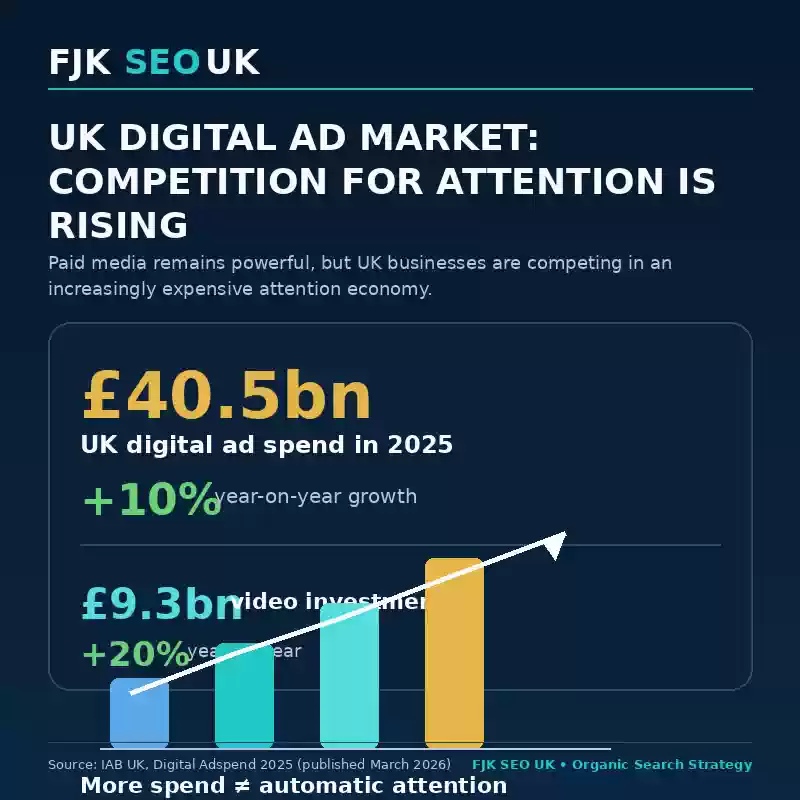
UK digital advertising statistics showing £40.5 billion ad spend in 2025 and rising competition for online attention, by FJK SEO UK.The UK Digital Market Is Becoming More Competitive for Attention

Advertising fatigue should not be interpreted as people suddenly refusing to engage with advertising.

It is better understood as an attention problem.

Consumers move constantly between Google, YouTube, social media, marketplaces, streaming platforms, email and websites. Every environment is competing for the same limited attention.

Ofcom’s 2026 research also describes UK adults as becoming more circumspect in their relationship with social media. Active posting, sharing and commenting among adult social-media users fell from 61% in 2024 to 49% in its latest research.

Trust is another consideration. In July 2026, Ofcom reported that 51% of UK adults had encountered potentially fraudulent online advertisements, with 36% saying they encountered them frequently. That does not mean legitimate advertising is inherently distrusted, but it demonstrates the increasingly complex environment in which genuine brands must compete for consumer confidence.

Businesses therefore need more than visibility.

They need credible visibility.

That is where organic search becomes strategically important.

.

Why Organic Search Attracts a Different Kind of Attention

Someone scrolling through social media has not necessarily asked to discover your business.

Someone searching Google for:

  • SEO consultant UK
  • technical SEO audit UK
  • commercial waste collection Manchester
  • local SEO services UK
  • camping equipment UK
  • ecommerce SEO consultant
  • best supplier for a particular industrial product

has actively expressed a requirement.

This is known as search intent.

SEO therefore operates differently from interruption-based advertising.

A good organic result does not have to manufacture the initial demand. It captures demand that already exists.

The user searches.

Google presents possible answers.

The user investigates those answers.

The business that appears relevant, credible and useful enters the buying process.

That is one of the fundamental reasons organic search remains commercially valuable.

What Is SEO in 2026?

For anyone asking what is SEO, what does SEO stand for, or looking for a simple SEO meaning, SEO stands for Search Engine Optimisation.

Traditionally, SEO meant improving a website so that search engines could crawl, understand and rank its pages.

That definition remains correct, but modern SEO is broader.

A strong SEO UK strategy now involves:

  • technical crawlability and indexation;
  • search-intent research;
  • useful service and product pages;
  • authoritative informational content;
  • internal linking;
  • digital PR and relevant backlinks;
  • structured data;
  • images and video;
  • local SEO;
  • Google Business Profile optimisation;
  • conversion optimisation;
  • brand credibility;
  • and visibility within AI-powered search experiences.

Google continues to state that its ranking systems are designed to prioritise helpful, reliable, people-first information rather than content created primarily to manipulate rankings.

SEO therefore increasingly sits at the intersection of search visibility, content quality, user experience and commercial credibility.

Organic SEO infographic showing technical SEO, helpful content, authority and structured data supporting Google Search, AI Overviews and AI Mode visibility.Google Search Is No Longer Just Ten Blue Links

One of the biggest changes affecting SEO in 2026 is the development of generative search.

Google Search can now include:

  • traditional organic results;
  • featured results;
  • AI Overviews;
  • AI Mode;
  • local packs;
  • Google Maps results;
  • product results;
  • images;
  • video;
  • knowledge features;
  • and other specialised search experiences.

AI Overviews help users understand more complex questions quickly, while AI Mode supports deeper research, comparisons and follow-up questions.

Importantly, Google says websites do not need a separate technical optimisation system to qualify for AI Overviews or AI Mode. Pages must be indexable and eligible to appear in Google Search, while existing SEO best practices continue to apply.

This changes the SEO conversation.

The objective is no longer simply:

Rank position number one for one keyword.

The objective becomes:

Build a website and content ecosystem that can become a relevant source across multiple search journeys.

That is a much more durable strategy.
AI Search Does Not Make SEO Obsolete

The growth of artificial intelligence has led to new terminology such as:

AI SEO, AEO, GEO and generative engine optimisation.

Some concepts behind these terms can be useful, particularly when they encourage businesses to structure information clearly and answer complex questions comprehensively.

But they should not be treated as replacements for SEO.

Google’s current guidance specifically recommends prioritising established SEO principles rather than pursuing supposed AEO or GEO shortcuts.

The same foundations matter:

CrawlabilityIndexationRelevanceQualityAuthorityUser Satisfaction

If Google cannot reliably crawl or understand a page, there is little reason to expect that page to become a useful source for an AI-generated result either.

AI search therefore increases the importance of good SEO rather than eliminating it.


The New Content Advantage: Non-Commodity Content

One of the most important developments in modern SEO is the movement away from generic content.

For years, businesses could publish articles such as:

“10 Benefits of SEO”

“5 Reasons You Need Digital Marketing”

“7 Tips for Choosing a Supplier”

Thousands of almost identical pages now exist.

Generative AI has made producing this kind of content even easier.

That means generic information itself has become less valuable.

Google’s latest guidance encourages businesses to create non-commodity content—material containing useful information, experience or insight that cannot simply be reproduced from common knowledge.

For a UK business, stronger content might include:

Original Experience

What actually happened during a project?

Case Studies

What problem did the customer have and how was it addressed?

Commercial Knowledge

What factors genuinely affect price, lead time or project feasibility?

Original Images

Show actual products, sites, processes, equipment or completed work.

Specialist Commentary

Explain something that someone with practical experience understands better than a generic writer.

Real Comparisons

Explain the advantages and limitations of competing approaches.

This is where expertise becomes a competitive advantage.

AI-Generated Content Needs Human Value

AI can be extremely useful for:

  • research;
  • structuring information;
  • generating ideas;
  • summarising complex material;
  • identifying content gaps;
  • improving readability;
  • and assisting content production.

The problem begins when websites generate hundreds or thousands of pages without providing additional value.

Google’s spam policies treat large-scale content created primarily to manipulate rankings as scaled content abuse, regardless of whether the material was generated by AI, humans or another method.

The correct approach is therefore not:

AI content versus human content.

It is:  low-value content versus genuinely useful content.

AI should accelerate expertise—not replace it.


SEO Builds Trust Before a Customer Contacts You

One of SEO’s most underestimated functions is pre-sales qualification.

Imagine a potential customer has:

  1. Searched for a service;
  2. Found your website;
  3. Opened several pages;
  4. Read your service information;
  5. Viewed a case study;
  6. Checked your company details;
  7. Compared you with competitors;
  8. Returned to Google before searching your brand.

By the time they make contact, a substantial amount of the sales process has already happened.

Good SEO therefore supports much more than traffic.

It supports confidence.

A strong business website should make important commercial questions easy to answer:

  • What does the company actually do?
  • Where does it operate?
  • Who does it work with?
  • What expertise does it have?
  • What does the process involve?
  • What could the service cost?
  • What evidence supports its claims?
  • How can a potential customer make contact?

SEO and conversion optimisation increasingly overlap.

Ranking brings the visitor.

Credibility helps convert the visitor.


Search Intent Matters More Than Search Volume Alone

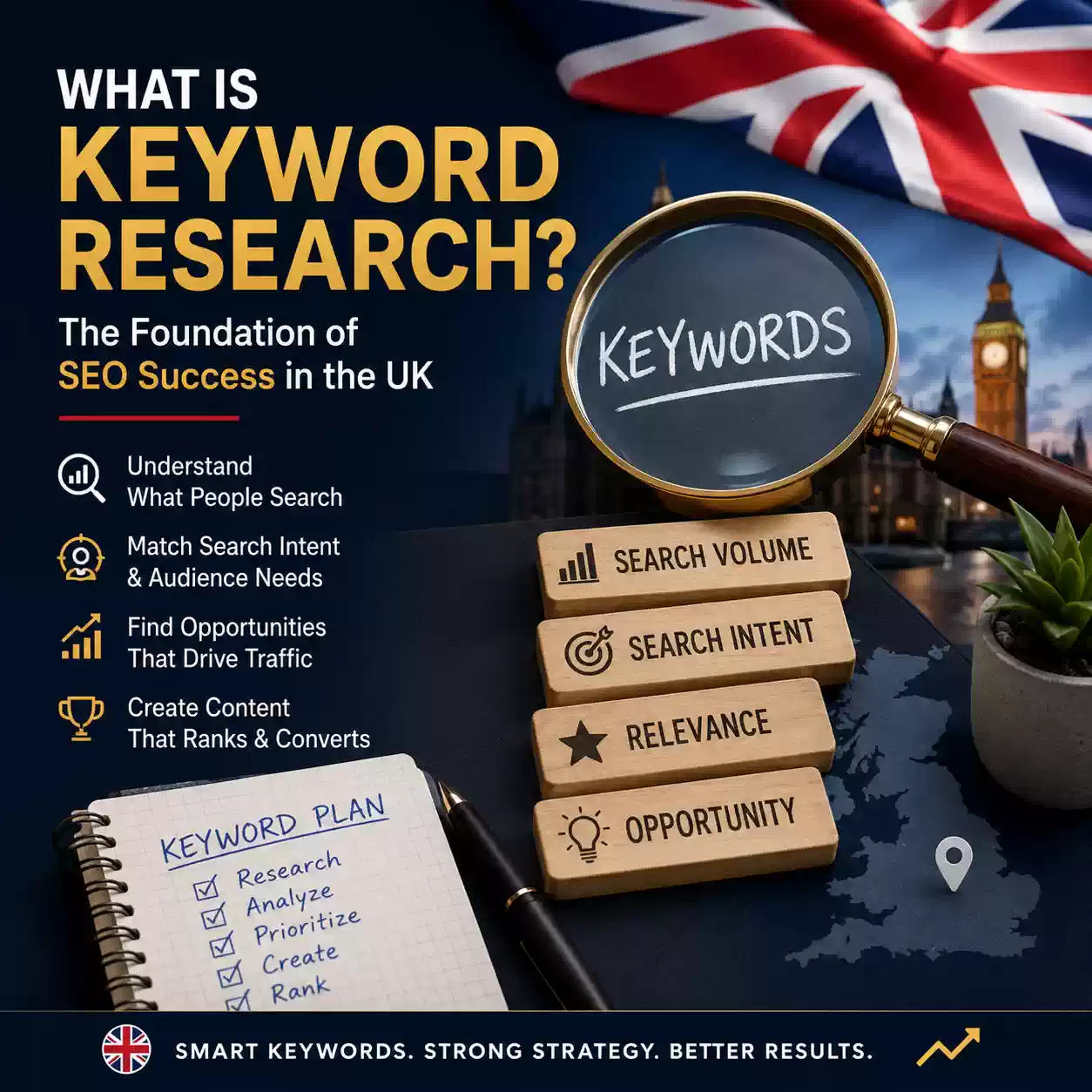
Traditional keyword research often concentrated heavily on monthly search volume.

Volume remains useful, but it should not control the entire strategy.

Consider these two searches:

“SEO”

and

“technical SEO consultant Manchester”

The first may attract considerably more searches.

The second may represent far stronger commercial intent.

Modern SEO therefore maps keywords according to the stage of the buying journey.

Informational Intent

“What is SEO?”

Problem-Aware Intent

“Why has my website traffic dropped?”

Solution-Aware Intent

“Technical SEO audit services”

Commercial Investigation

“Best SEO consultant UK”

Transactional Intent

“Hire SEO consultant Manchester”

A commercially focused SEO strategy should develop content across this complete journey rather than chasing traffic for its own sake.

Core Web Vitals infographic showing recommended LCP, INP and CLS performance thresholds for technical SEO and website user experience.Technical SEO Remains the Infrastructure Behind Organic Visibility

Content cannot compensate indefinitely for a technically weak website.

Search engines still need to:

discovercrawlrenderunderstand → index → retrieve

your pages.

Technical SEO therefore remains essential.

Important areas include:

Crawlability

Search engines must be able to discover important URLs.

Indexation

Important pages need to be eligible for inclusion in search results.

Site Architecture

Products, services, categories and informational content should exist within a logical hierarchy.

Internal Linking

Important pages should receive contextual internal links from related content.

Canonicalisation

Duplicate and near-duplicate URLs should be managed correctly.

XML Sitemaps

Search engines should have an efficient route to important URLs.

Mobile Experience

Google uses mobile-first indexing, so essential content and structured information must remain available on mobile pages.

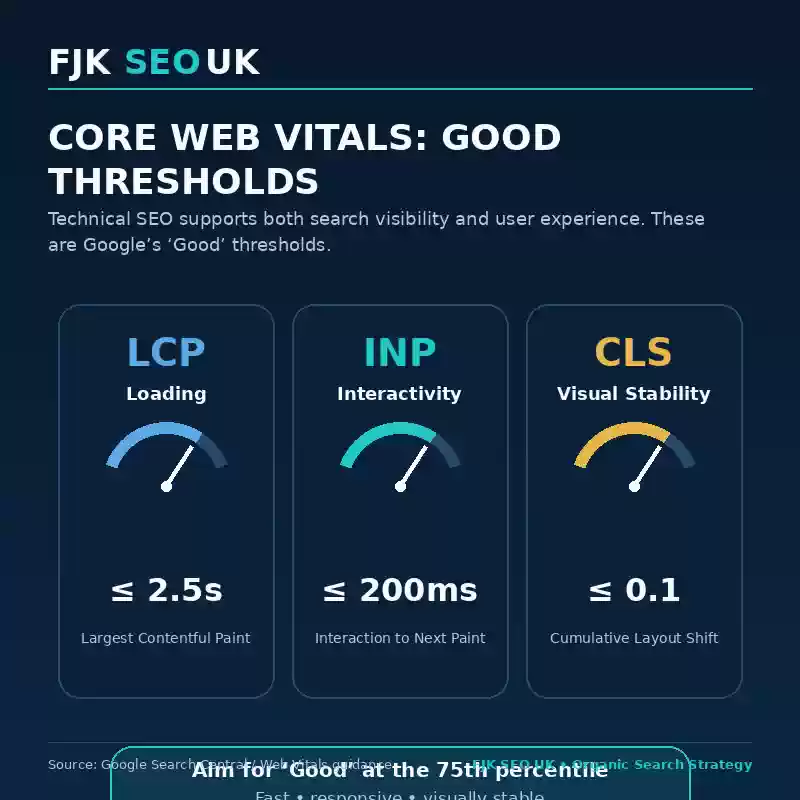
Core Web Vitals

Google continues to use Core Web Vitals within its ranking systems, although good scores alone do not guarantee high rankings.

Technical SEO is not glamorous.

But it determines whether everything else has a strong foundation.

Local SEO UK infographic explaining relevance, distance and popularity alongside Google Business Profile, reviews and locally relevant website content.Local SEO Is Becoming More Important for UK Businesses

For businesses serving specific towns, cities, counties or service areas, local SEO deserves its own strategy.

A customer searching:

“SEO consultant near me”

“waste management company Manchester”

“accountant Birmingham”

“commercial electrician Leeds”

“camping shop near me”

is expressing both service intent and geographic intent.

Google states that local results are primarily influenced by relevance, distance and popularity.

A strong UK local search strategy may therefore involve:

  • accurate Google Business Profile information;
  • appropriate business categories;
  • genuine customer reviews;
  • locally relevant service pages;
  • consistent business information;
  • locally relevant links and citations;
  • original photographs;
  • useful location-specific content;
  • and a technically strong website.

A Google Business Profile should therefore not operate separately from the website.

The website builds topical and commercial depth.

The Business Profile strengthens local discovery.

Together they create a stronger local search presence.

This is the basis of effective local SEO services UK businesses increasingly require.


Structured Data Helps Search Engines Understand Businesses

Structured data is another important part of modern SEO.

It does not automatically improve rankings.

Instead, it provides machine-readable information that helps search engines understand particular entities and page elements.

Depending on the website, useful schema can include:

  • Organization
  • LocalBusiness
  • Product
  • Offer
  • Article
  • BreadcrumbList
  • VideoObject

Google confirms that structured data helps it understand the content and entities represented on a webpage, although correct implementation does not guarantee a particular rich-result appearance.

Structured data should therefore support the content rather than attempt to manipulate it.

Organic SEO Reduces Dependence on Paid Advertising

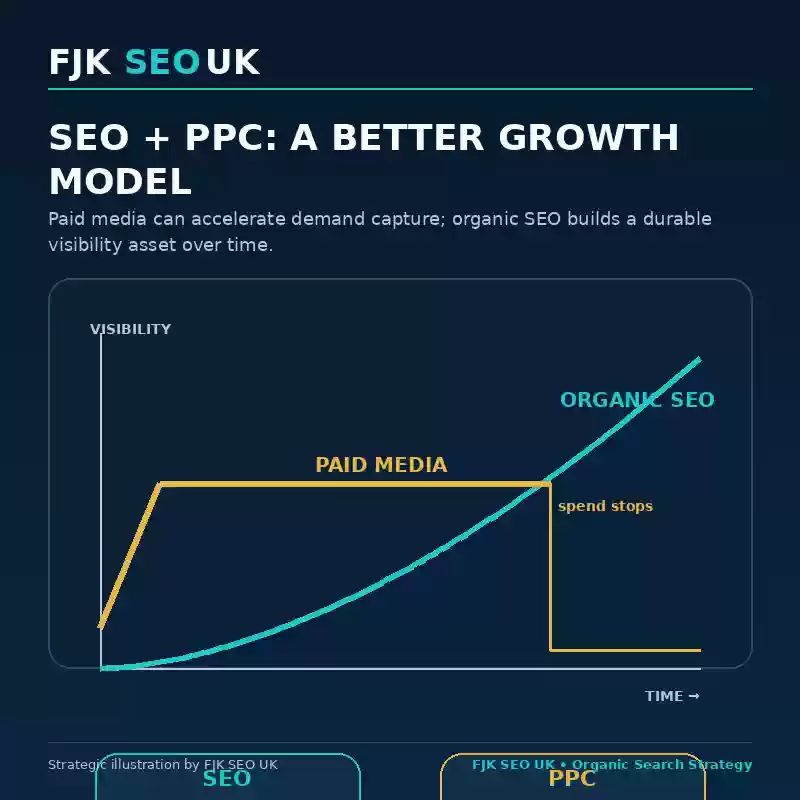
One of organic search’s greatest commercial advantages is its ability to create a reusable digital asset.

A paid campaign normally requires continued spending to maintain advertising visibility.

An established organic page can potentially continue generating:

  • impressions;
  • rankings;
  • qualified visits;
  • enquiries;
  • brand searches;
  • backlinks;
  • and conversions

long after its original publication.

That does not mean SEO is free.

Businesses still invest in:

  • research;
  • content;
  • development;
  • technical improvements;
  • digital PR;
  • expertise;
  • design;
  • monitoring;
  • and optimisation.

The difference is that these investments improve assets the business controls—its website, content library and organic presence.

The effect can compound over time.

SEO and PPC comparison graphic showing paid advertising delivering immediate visibility while organic SEO builds sustainable long-term search visibility.SEO and PPC Should Work Together

It would be a mistake to conclude that SEO should replace paid search entirely.

A mature digital strategy uses each channel for what it does best.

PPC Is Particularly Useful For

  • immediate visibility;
  • product launches;
  • promotions;
  • testing new offers;
  • targeting specific commercial searches;
  • and entering markets quickly.

SEO Is Particularly Useful For

  • sustained search visibility;
  • reducing long-term dependency on purchased traffic;
  • answering complex customer questions;
  • building topical depth;
  • increasing brand discovery;
  • local search visibility;
  • and capturing demand throughout the buying journey.

A powerful model is therefore:

SEO = long-term infrastructure

Paid media = controlled acceleration

The channels should reinforce one another rather than compete internally for budget.
Organic Visibility Can Strengthen Brand Demand

An important stage of SEO maturity occurs when users stop searching only for a service and begin searching specifically for the company.

For example:

First search:

“SEO consultant UK”

Later search:

“FJK SEO UK”

The first query represents category demand.

The second represents brand demand.

Strong organic visibility, useful content, external mentions, social visibility and satisfied customers can all contribute to this transition.

That is when SEO starts supporting something more valuable than keyword rankings:

brand recall.

And a recognised brand is less dependent on constantly buying attention.

Optimising for AI Search Means Becoming a Better Source

Google’s generative search guidance creates an important strategic principle for businesses:

Do not optimise primarily for an AI system. Optimise your website so that it becomes a genuinely useful source.

Google recommends unique, expert-led and non-commodity content, clear site structure, relevant images and video, and established SEO fundamentals for generative search visibility.

That means businesses should increasingly publish material such as:

  • original research;
  • expert commentary;
  • first-hand case studies;
  • detailed product information;
  • practical guides;
  • original photography;
  • demonstrations;
  • comparison content;
  • technical explanations;
  • and proprietary data.

These resources are valuable to humans first.

That is precisely why they can also become useful to search and AI systems.

Measuring SEO Success in 2026

Ranking reports alone no longer provide a complete picture.

A modern SEO dashboard should consider several dimensions.

This is particularly important.

SEO performance increasingly needs to be measured across search ecosystems, not simply ten blue links.

Organic Visibility

Track impressions and query coverage through Google Search Console.

Monitor the searches and pages generating visits.

Measure enquiry forms, telephone calls, emails and other meaningful actions.

For ecommerce websites, connect organic landing pages with transactions and revenue.

Monitor Google Business Profile interactions and local visibility.

Track growth in branded searches.

Monitor appearances across images, video, products and other search features where relevant.

In June 2026, Google announced dedicated Search Console reporting for visibility in generative AI features such as AI Overviews and AI Mode. The feature is initially being rolled out to a subset of websites, so it may not yet appear in every Search Console property.

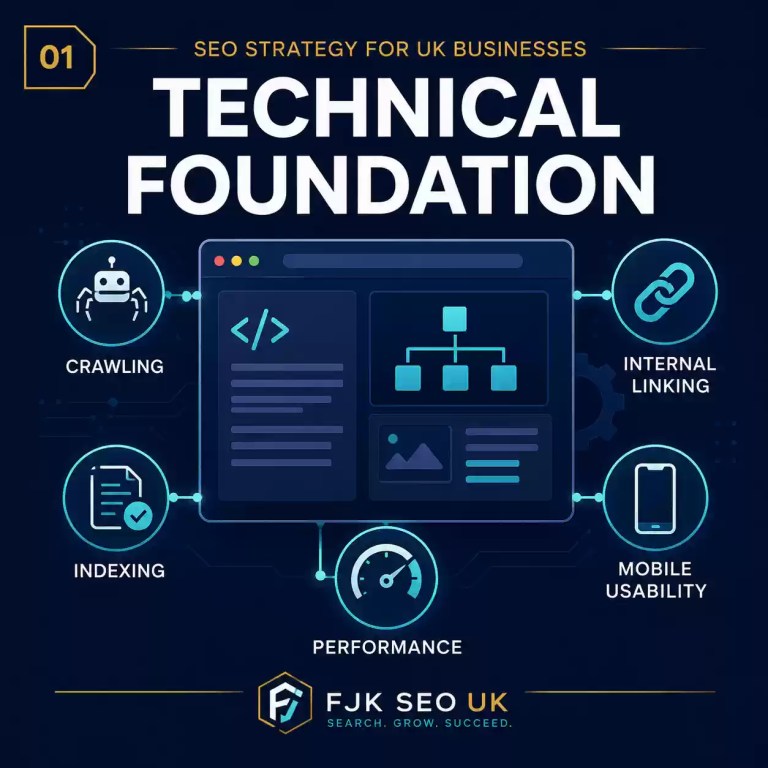
A Practical Organic SEO Strategy for UK Businesses

A sustainable strategy can be organised around six connected areas.


Technical Foundation

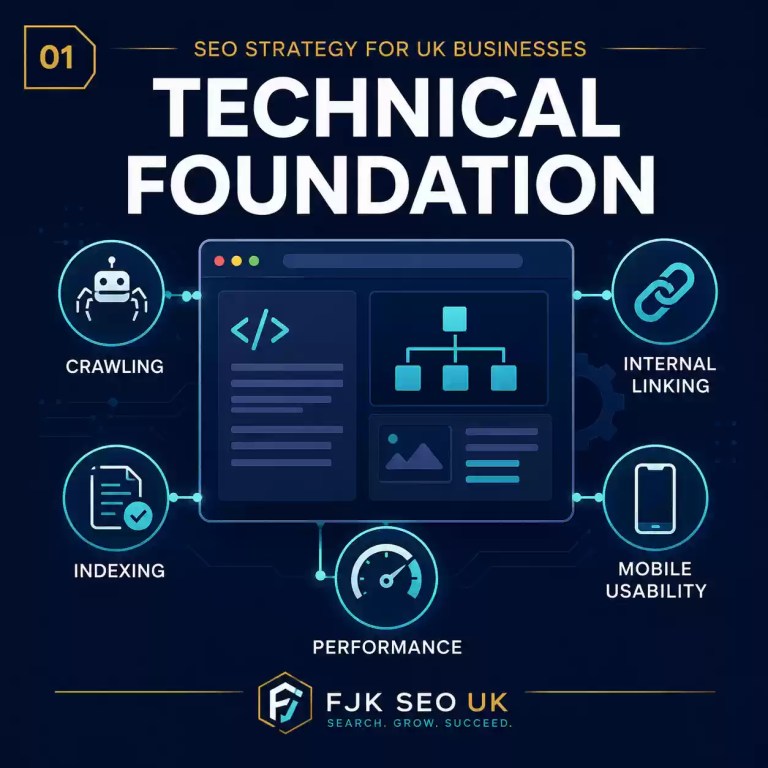
Fix crawling, indexing, canonicalisation, internal linking, mobile usability and performance issues.

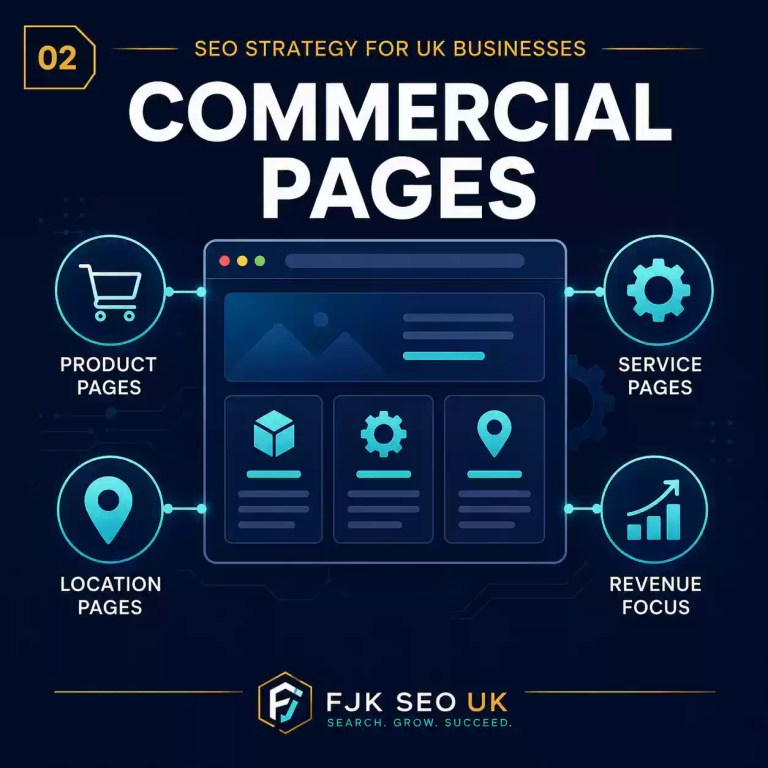
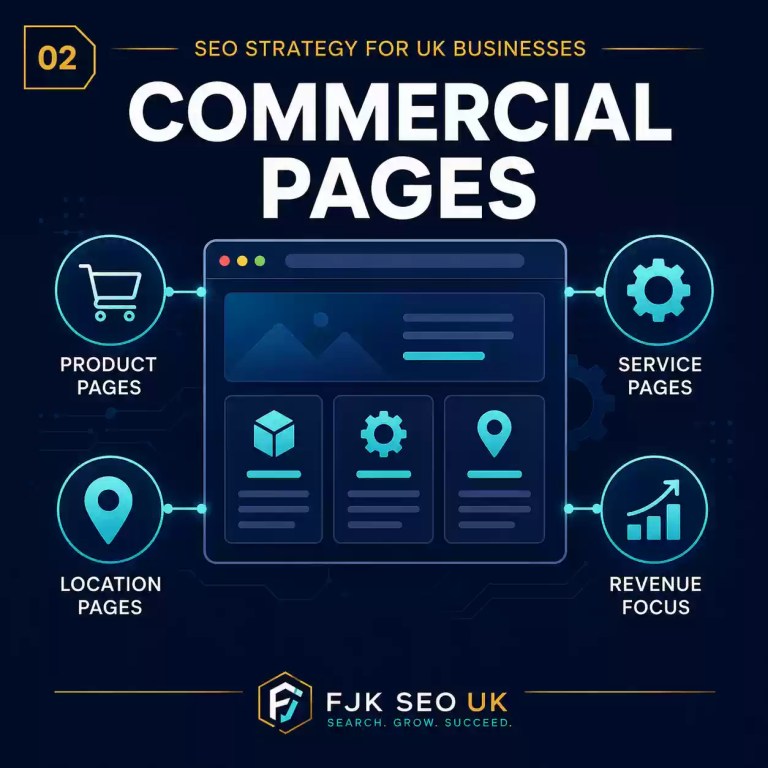
Build strong pages for the products, services and locations that genuinely generate revenue.

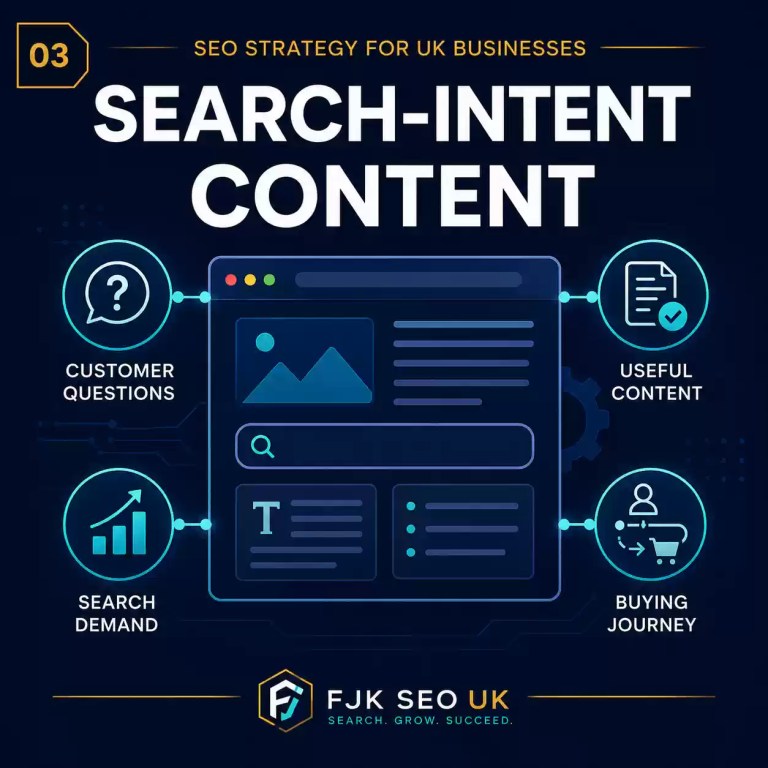
Create supporting information around the questions customers ask before purchasing.

Add case studies, original photographs, examples, expert commentary and practical business knowledge.

Earn relevant links, citations, mentions and digital PR rather than pursuing arbitrary backlink quantities.

Use Search Console, analytics, conversion tracking and Business Profile data to determine what is actually producing commercial value.

The strategy becomes a cycle:

ResearchBuildPublishEarn VisibilityMeasureImprove

SEO is therefore not a one-off website task.

It is an ongoing business-development channel.


Organic SEO strategy flow chart showing technical SEO, commercial pages, search-intent content, experience, authority development and measurement as a continuous SEO growth cycle.A Practical Organic SEO Strategy for UK Businesses

A sustainable strategy can be organised around six connected areas.

1. Technical Foundation

Fix crawling, indexing, canonicalisation, internal linking, mobile usability and performance issues.

2. Commercial Pages

Build strong pages for the products, services and locations that genuinely generate revenue.

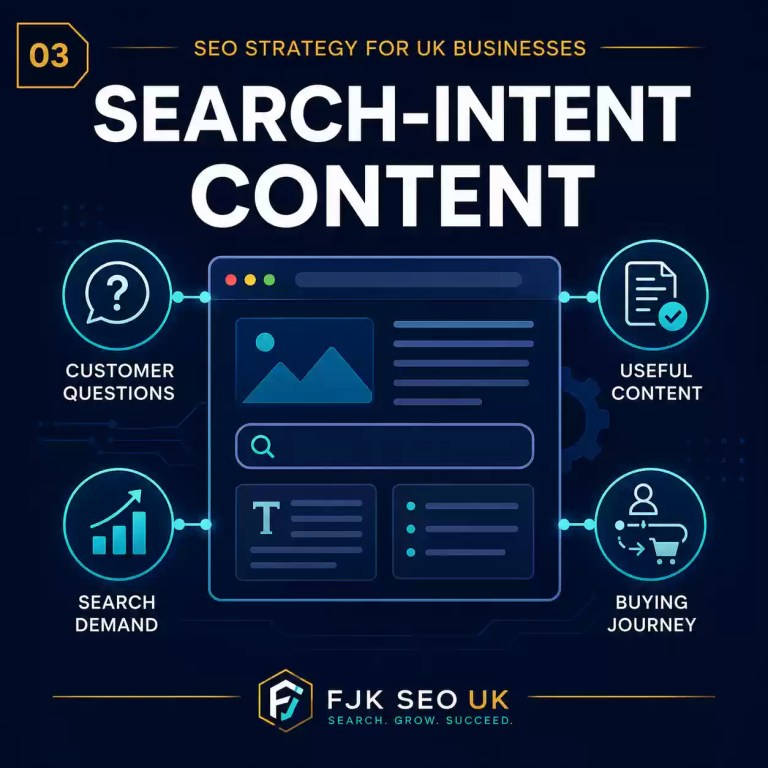
3. Search-Intent Content

Create supporting information around the questions customers ask before purchasing.

4. Experience and Evidence

Add case studies, original photographs, examples, expert commentary and practical business knowledge.

5. Authority Development

Earn relevant links, citations, mentions and digital PR rather than pursuing arbitrary backlink quantities.

6. Measurement and Improvement

Use Search Console, analytics, conversion tracking and Business Profile data to determine what is actually producing commercial value.

The strategy becomes a cycle:

Research BuildPublishEarn VisibilityMeasureImprove

SEO is therefore not a one-off website task.

It is an ongoing business-development channel.


Why Organic SEO Is Becoming More Valuable, Not Less

The emergence of AI search initially created a fear that traditional SEO would disappear.

The opposite argument is increasingly persuasive.

AI-powered search systems still require useful information.

They still need websites.

They still need products, businesses, experts, research, images, videos and original sources from which to build useful search experiences.

Google itself states that foundational SEO best practices remain applicable to its generative AI search features.

The opportunity therefore shifts from simply:

“How do we rank a keyword?”

towards:

“How do we become one of the most useful and trustworthy sources in our commercial niche?”

That is a much stronger business objective.


Final Thoughts: Why Organic SEO Is a Smart UK Growth Strategy

Paid advertising will remain an important part of digital marketing.

Social media will remain important.

Email will remain important.

Marketplaces will remain important.

AI platforms will become increasingly important.

But businesses need a digital asset they control at the centre of those channels.

That asset is their website.

SEO strengthens that asset.

A well-executed organic strategy can help a UK business:

  • Appear when customers are actively searching;
  • Capture high-intent demand;
  • Build trust before first contact;
  • Develop local visibility;
  • Reduce excessive dependence on paid acquisition;
  • Strengthen brand recognition;
  • Build durable content assets;
  • Improve visibility across both traditional and AI-powered search.

The objective is therefore not simply more traffic.

It is to become easier to discover, easier to understand and easier to trust.

That is why organic SEO remains one of the foundations of sustainable digital growth.

FJK SEO BANNER IMAGE -SEO UKHow FJK SEO UK Can Help

FJK SEO UK supports businesses that want organic search to become a measurable commercial channel rather than simply another marketing activity. The approach combines:
Technical SEO

Crawling, indexation, site architecture, internal linking and performance.

Keyword research, search-intent mapping and competitive analysis.

Commercial landing pages, expert-led content and topical development.

Google Business Profile optimisation, local search strategy and geographic visibility.

Building technically accessible, well-structured and genuinely useful content capable of competing across traditional and generative search experiences.

Category architecture, product optimisation, structured product information and commercial search visibility.

The goal is not simply to obtain rankings.

It is to connect rankings, visibility and content with qualified enquiries, customers and revenue.

Need a stronger organic search strategy for your UK business? Contact FJK SEO UK for an SEO audit and practical growth plan.

Frequently Asked Questions

What is SEO and what does SEO stand for?

SEO stands for Search Engine Optimisation. It involves improving a website’s technical structure, content, relevance and authority so search engines can understand it and present relevant pages to users searching for related information, products or services.

Is organic SEO better than paid advertising?

Neither channel is universally better. Paid advertising can generate immediate visibility, while SEO is generally designed to create sustainable organic visibility over a longer period. Many businesses achieve the strongest results by using paid campaigns alongside an established SEO strategy.

Does AI Mode mean SEO is becoming obsolete?

No. Google states that existing SEO best practices remain relevant for AI Overviews and AI Mode. Websites still need crawlable, indexable, useful and reliable content to be eligible to appear as supporting sources.

Can AI-generated content rank on Google?

AI-assisted content can appear in search results when it is accurate, relevant and genuinely useful. Producing large volumes of low-value content primarily to manipulate rankings can, however, conflict with Google’s scaled content abuse policy.

What is local SEO?

Local SEO helps businesses improve visibility for geographically relevant searches. It normally combines website optimisation, locally relevant content, Google Business Profile optimisation, reviews and other signals that help users discover appropriate businesses in their area.

Does a Google Business Profile help local SEO?

A complete and accurately maintained Google Business Profile is an important component of local search visibility. Google states that local results are primarily influenced by relevance, distance and popularity, so the Business Profile should work alongside a strong website and broader local presence.

How long does SEO take to work in the UK?

There is no fixed period. Results depend on competition, website condition, existing authority, content quality, technical problems and the searches being targeted. Some improvements may appear relatively quickly, while competitive organic growth normally requires sustained work over several months.

Is SEO still worthwhile when Google shows AI Overviews?

Yes. Google states that the same foundational SEO practices used for conventional Search also apply to AI features. The strategic emphasis is increasingly on producing original, useful and expert-led information rather than chasing artificial optimisation shortcuts.


Share this:

Like this:

Like Loading…

Discover more from FJK SUBLI

Subscribe now to keep reading and get access to the full archive.

Continue reading