


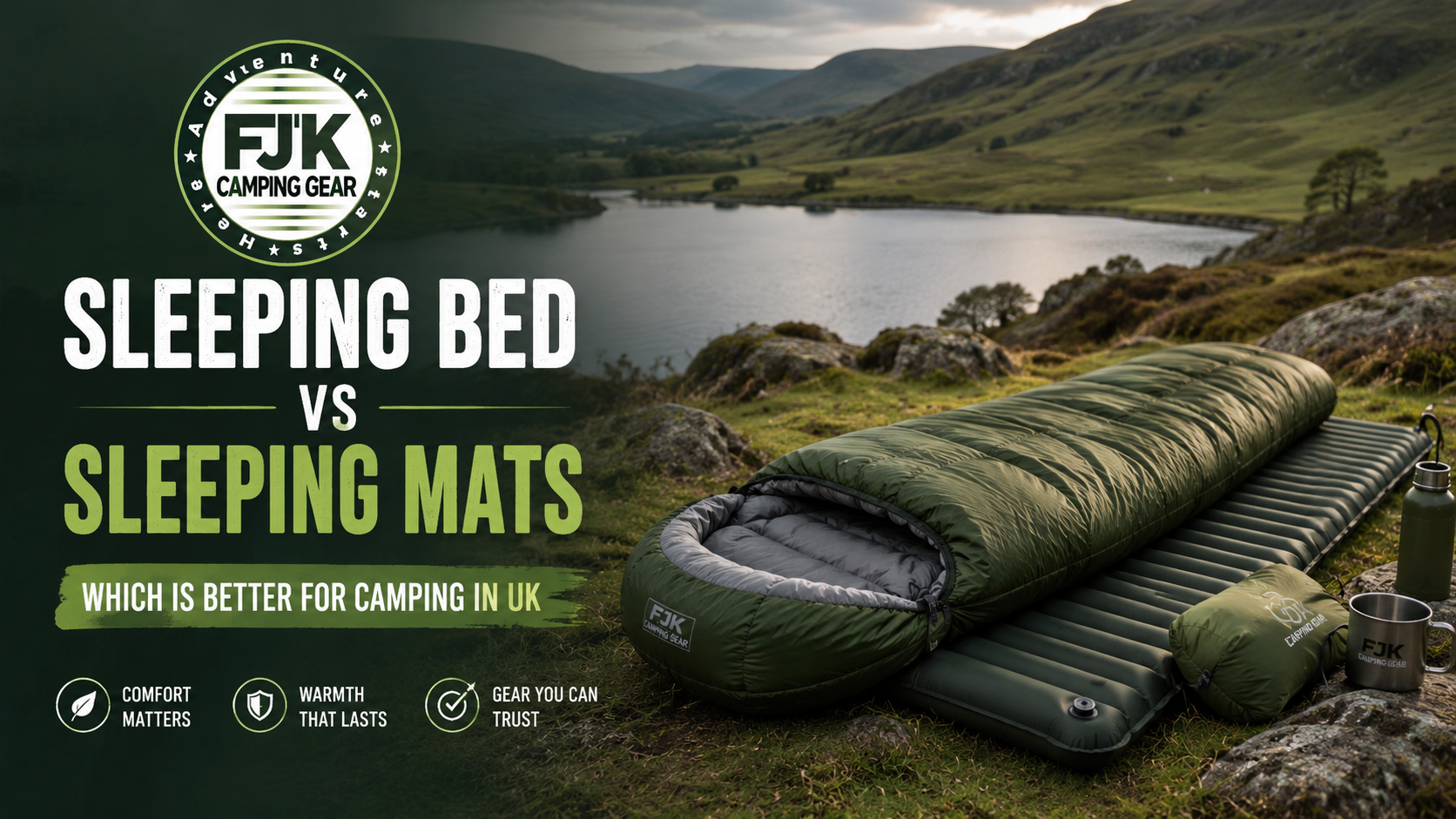
Air Bed vs Sleeping Mat for Camping: Which Is Better for UK Campers?
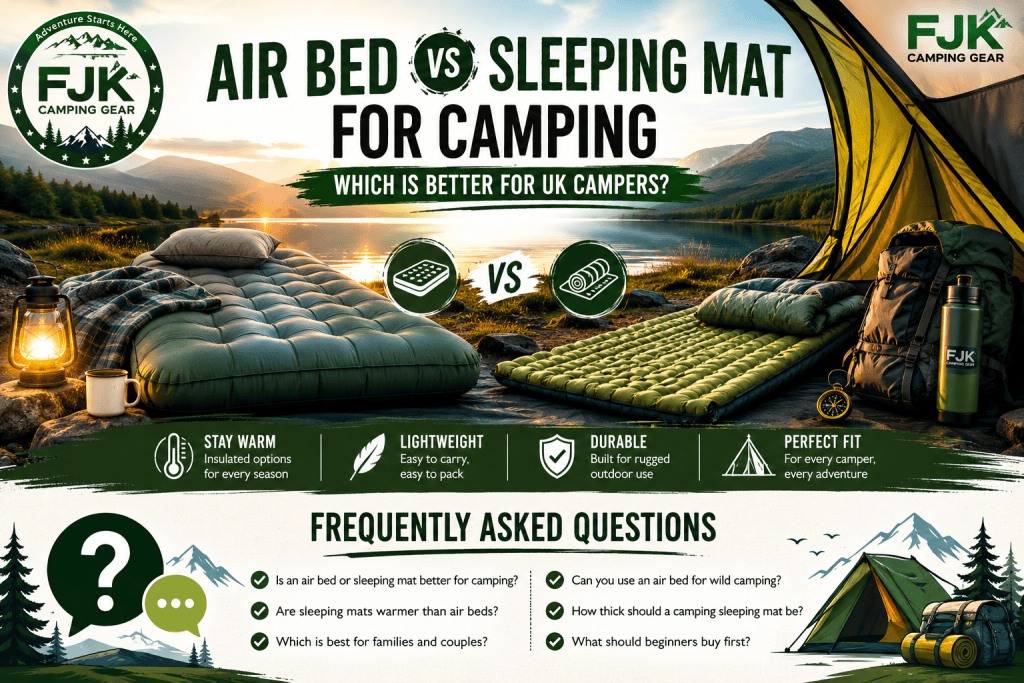
For most UK campers, a sleeping mat is the more practical and reliable choice, especially for cooler nights, walking trips, smaller tents and beginner wild camping. An air bed can be more comfortable for campsite and car camping, particularly for couples and families who have a larger tent, easy vehicle access and space for a pump.
The best choice depends on how you camp. A family staying on an organised campsite in Cornwall will have different needs from a solo camper carrying gear across Dartmoor or the Scottish Highlands. British weather also matters: even in summer, damp ground, rain and chilly overnight temperatures can make the wrong sleeping system feel uncomfortable. Read more to know more about Air bed vs sleeping mat for camping
Quick Answer: Air Bed or Sleeping Mat?
| Camping situation | Better choice | Why |
| First family campsite trip | Air bed or thick self-inflating mat | More comfort and easier setup when carrying gear by car |
| Couple camping in a large tent | Double air bed or double self-inflating mat | More sleeping space and shared comfort |
| Solo weekend campsite camper | Self-inflating sleeping mat | Comfortable, compact and easier to manage |
| Festival camping | Sleeping mat | Less bulky and easier to carry |
| Car camping | Air bed or thick camping mat | Weight and packed size matter less |
| Beginner wild camping | Insulated sleeping mat | Lightweight, compact and better suited to carrying |
| Spring or autumn camping | Insulated sleeping mat | Better protection from cold ground |
| Camping with limited tent space | Sleeping mat | Lower profile and easier to fit |
Simple recommendation: Choose an air bed for comfort-focused campsite camping with vehicle access. Choose an insulated sleeping mat for warmth, portability and more flexible UK camping.
What Is the Difference Between an Air Bed and a Sleeping Mat?
An air bed is an inflatable mattress designed mainly for comfort and sleeping height. It is usually thicker than a camping mat and is often inflated using a hand pump, foot pump, electric pump or rechargeable pump. Air beds are popular with families, couples and campsite campers because they can feel more like sleeping on a normal bed.
A sleeping mat is designed to create a comfortable and insulating barrier between your sleeping bag and the ground. Sleeping mats include:
- Closed-cell foam mats
- Lightweight inflatable mats
- Self-inflating camping mats
- Thicker insulated camping mattresses
- Double sleeping mats for couples
Unlike a standard air bed, many camping sleeping mats are specifically designed to reduce heat loss into the ground. This is important in the UK, where soil and grass can remain cool and damp even after a mild day.
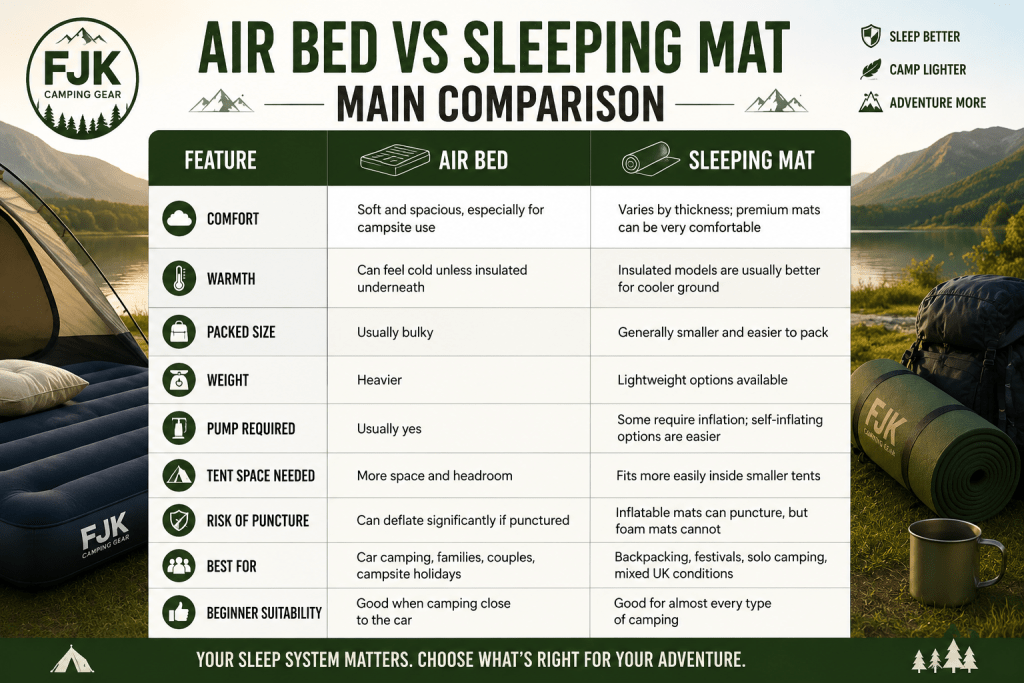
Air Bed vs Sleeping Mat: Main Comparison
| Feature | Air bed | Sleeping mat |
| Comfort | Soft and spacious, especially for campsite use | Varies by thickness; premium mats can be very comfortable |
| Warmth | Can feel cold unless insulated underneath | Insulated models are usually better for cooler ground |
| Packed size | Usually bulky | Generally smaller and easier to pack |
| Weight | Heavier | Lightweight options available |
| Pump required | Usually yes | Some require inflation; self-inflating options are easier |
| Tent space needed | More space and headroom | Fits more easily inside smaller tents |
| Risk of puncture | Can deflate significantly if punctured | Inflatable mats can puncture, but foam mats cannot |
| Best for | Car camping, families, couples, campsite holidays | Backpacking, festivals, solo camping, mixed UK conditions |
| Beginner suitability | Good when camping close to the car | Good for almost every type of camping |
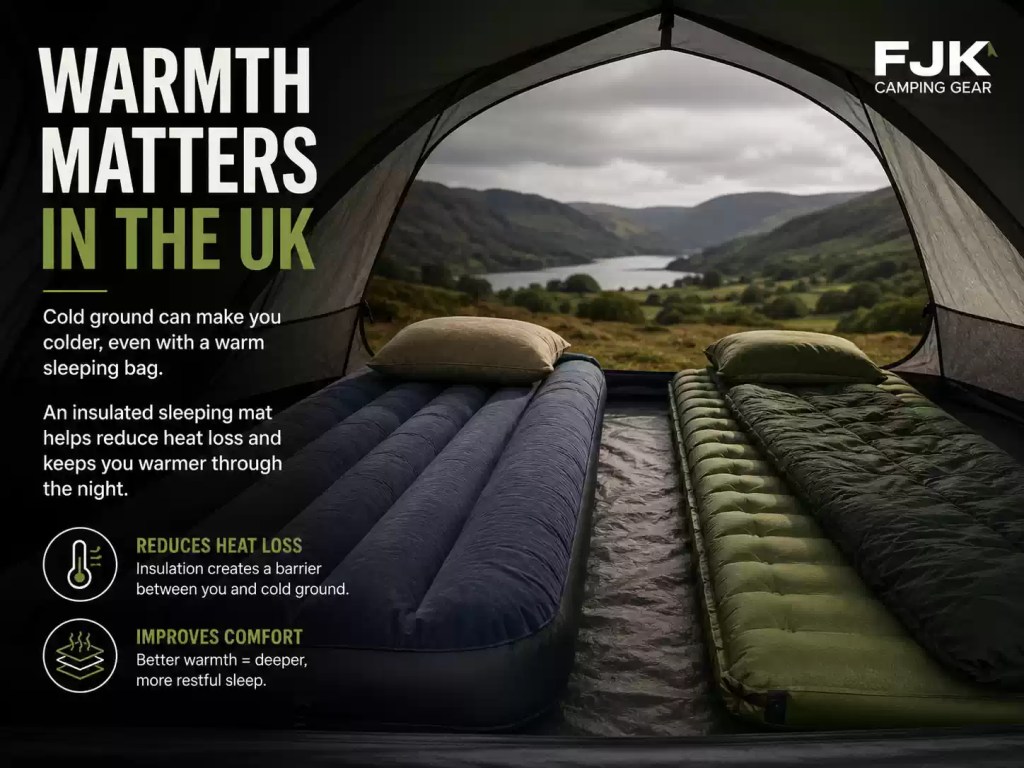
Which Is Warmer: An Air Bed or Sleeping Mat?
For British camping conditions, warmth is often more important than softness.
An air bed raises you away from the ground, but the large volume of air inside it can still become cold overnight. Without insulation underneath or inside the bed, you may feel chilled even when your sleeping bag seems warm enough.
A camping sleeping mat is designed to reduce heat transfer between your body and the cold ground. Insulated inflatable mats and self-inflating mats are generally a stronger choice for spring, autumn and cooler summer nights.
Why Ground Insulation Matters in the UK
UK campers often focus on buying a warm sleeping bag, then overlook the sleeping surface beneath it. When you lie down, the insulation underneath your sleeping bag becomes compressed. This means your mat or mattress plays an important role in keeping cold from rising through the tent floor.
For typical British camping:
- Warm summer campsite nights: a basic sleeping mat or comfortable air bed may be suitable.
- Changeable summer weather: a self-inflating or insulated sleeping mat offers greater reassurance.
- Spring and autumn camping: choose an insulated sleeping mat rather than relying on a basic air bed.
- Cold-weather or winter camping: use a properly insulated camping mat suited to low temperatures and combine it with an appropriate sleeping bag.
When comparing mats, look for an R-value, which indicates thermal resistance. In simple terms, the higher the R-value, the more insulation the mat provides from cold ground.
Beginner tip: A thick bed is not automatically a warm bed. For UK camping, always check insulation as well as comfort.
Which Is More Comfortable for Camping?
Comfort depends on your sleeping style, body support needs and the type of trip you are planning.
Air Bed Comfort
An air bed can feel familiar and comfortable because it offers:
- More depth between you and the ground
- A larger sleeping area
- Double sizes for couples
- Easier movement for people who dislike lying close to the tent floor
This makes air beds appealing for family campsite trips, relaxed weekend breaks and camping holidays where the car is parked close to the pitch.
However, air beds can lose pressure overnight, wobble when two people move, and occupy a large area of the tent. In smaller tents, a tall air bed can also bring sleeping bags closer to the sloping tent walls, where condensation may be present.
Sleeping Mat Comfort
A basic foam mat is lightweight and reliable, but it may feel too thin for first-time campers wanting a comfortable night.
A self-inflating or thicker inflatable sleeping mat offers a better balance of:
- Cushioning
- Support
- Insulation
- Smaller packed size
- Easier use in a wider range of tents
For many beginner UK campers, a good-quality self-inflating mat is a sensible middle ground: more comfortable than a thin foam roll mat, but more practical than a large air bed.
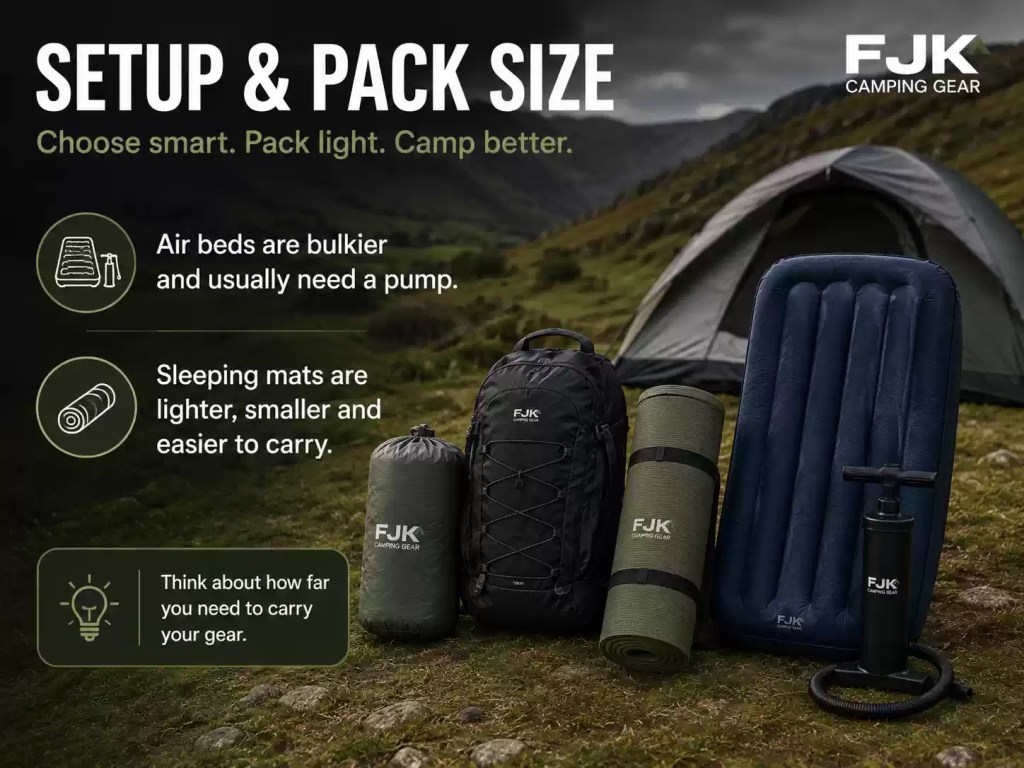
Which Is Easier to Carry and Set Up?
Carrying an Air Bed
An air bed is usually most suitable when you are travelling by car. You may also need to pack:
- A pump
- Spare batteries or charging cable for an electric pump
- A puncture repair kit
- Extra bedding or a fitted sheet
- A protective ground layer
For a short walk from the car to a campsite pitch, this is usually manageable. For festivals, hill walking or remote camps, it quickly becomes inconvenient.
Carrying a Sleeping Mat
Sleeping mats are designed with portability in mind. Depending on the style, they may roll or pack down into a small carry bag.
They are usually better for:
- Train or bus travel to a campsite
- Festival camping
- Cycle touring
- Solo campers
- Backpacking
- Beginner wild camping where legal and appropriate
A sleeping mat also avoids the frustration of taking a large air bed on a trip, only to discover that it barely fits inside the tent sleeping area.
Air Bed vs Sleeping Mat for Families
For families camping at an organised UK campsite, comfort and convenience are often the main priorities. Parents may be carrying more equipment anyway, and children often sleep better when the setup feels comfortable and secure.
An Air Bed May Suit Families When:
- You are driving directly to the campsite
- You have a large family tent
- You are camping for several nights
- Comfort matters more than packed size
- You can bring a reliable pump
A Sleeping Mat May Suit Families When:
- You want separate beds for each child
- You are limited on tent space
- You need warmer sleeping surfaces
- You want equipment that is easier to store between trips
- Your children may be likely to jump on or damage an air bed
A practical family setup can be a combination: thicker camping mats or self-inflating mattresses for adults, with smaller sleeping mats for children.
Explore comfortable camping beds and sleeping gear UK for family camping weekends, festivals and summer holidays.
Air Bed vs Sleeping Mat for Couples
Couples often want enough sleeping space without turning the entire tent into a bedroom.
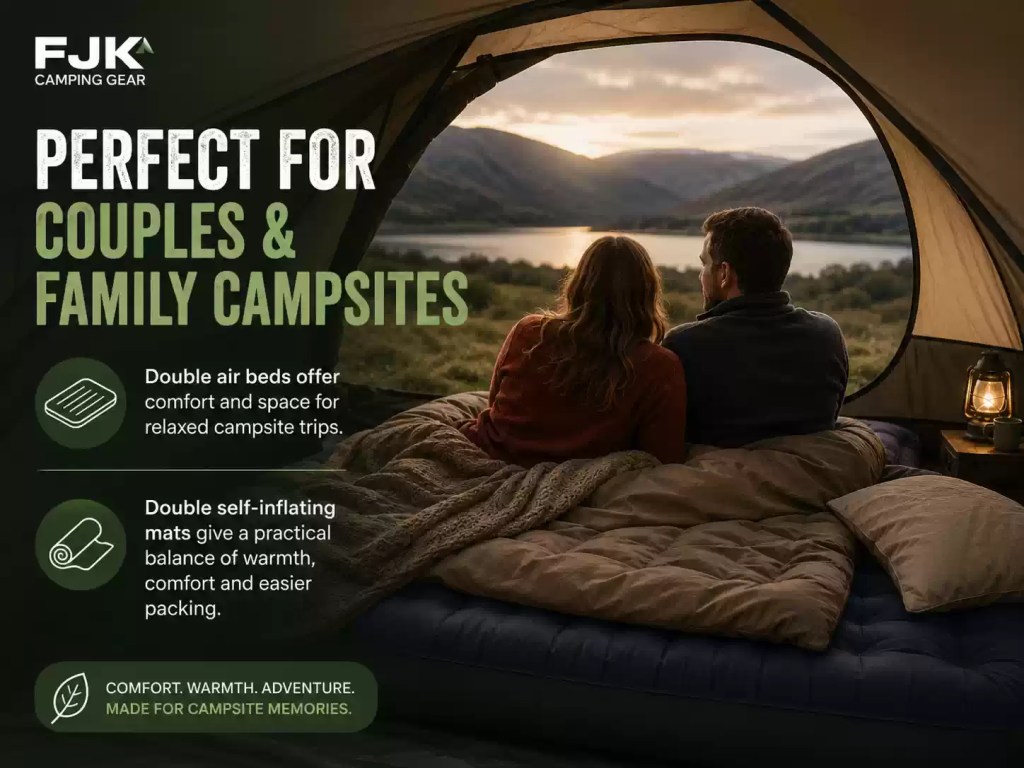
A double air bed offers a familiar shared sleeping surface and can be comfortable in a spacious tent. It works well for car camping, weekend campsite breaks and longer stays where carrying weight is not a concern.
A double self-inflating sleeping mat is often the more practical option for UK camping because it can provide:
- Better insulation
- Less height inside the tent
- Easier packing
- More stability
- Reduced reliance on a bulky pump
Couples using separate sleeping bags may also prefer two individual mats placed together. This prevents one person’s movement from disturbing the other and gives more flexibility if one mat needs replacing later.
Air Bed vs Sleeping Mat for Solo Campers
For a solo beginner, a sleeping mat is usually the better first purchase.
A single insulated mat takes up less space, is easier to pack and works for more types of trip. It can be used for an organised campsite weekend, a festival, a lightweight walking trip or a first responsible backpack camping experience.
A single air bed may still suit solo campers who:
- Use a larger tent
- Camp directly beside their vehicle
- Prioritise comfort above portability
- Prefer a raised sleeping surface
However, for flexibility and value over time, a well-chosen sleeping mat is usually a better starting point.
Best Choice for Campsite Camping
For beginners, an established campsite is often the easiest and most comfortable place to start. You may have nearby toilets, level pitches, parking and fewer worries about access or overnight regulations.
At a campsite, either option can work:
Choose an Air Bed for Campsite Camping When:
- Your tent is large enough
- You are arriving by car
- You want maximum softness
- You are camping during milder weather
- You can keep your bedding protected from damp conditions
Choose a Sleeping Mat for Campsite Camping When:
- You want a compact setup
- You expect cooler nights
- You have a smaller tent
- You want one sleep system that can be used on future trips
- You want easier packing when the trip ends
For most first-time campsite campers, a thick self-inflating mat provides an excellent combination of warmth, comfort and convenience.
Best Choice for Car Camping
Car camping gives you more freedom because you do not need to carry everything on your back. If your pitch is close to the vehicle, bulk and weight become less important.
An air bed can be a good option for:
- Family camping holidays
- Couples using large tents
- Weekend campsite trips
- Campers who need extra cushioning
However, British weather can change quickly. Even when travelling by car, pack with cool and wet conditions in mind. Bring a suitable sleeping bag, waterproof storage for bedding, warm nightwear and a sleeping surface that will not leave you cold after rain lowers the overnight temperature.

Best Choice for Beginner Wild Camping
For beginner wild camping, a sleeping mat is the clear choice. An air bed is generally too bulky and impractical to carry into a remote location.
A suitable lightweight sleeping mat should be:
- Compact enough for a rucksack
- Comfortable enough for uneven ground
- Insulated for the expected temperature
- Easy to inflate and deflate
- Durable enough for outdoor use
Important UK Access Note
Wild camping rules differ across the UK:
- In Scotland, responsible lightweight camping is generally permitted under the Scottish Outdoor Access Code, with important responsibilities around litter, fires, water, parking and respecting others.
- In most of England and Wales, landowner permission is generally required before wild camping.
- On Dartmoor, backpack camping is permitted only in approved mapped areas and is intended for lightweight camping, not large family tents or vehicles.
- In areas such as the Lake District and Eryri, campers should not assume they can wild camp without prior landowner permission.
Beginners who want a quieter outdoor experience without legal uncertainty may prefer a small rural campsite, nearly-wild campsite or permitted backpack camping area.
Choosing Sleeping Gear for British Weather
The UK does not require extreme conditions to make camping uncomfortable. A mild weekend can still bring rain, damp grass, wind and unexpectedly chilly nights.
1. Prepare for Damp Ground
Whether you choose an air bed or sleeping mat, place it inside a properly pitched tent with a sound groundsheet. Do not allow wet clothes, muddy boots or damp equipment to soak the sleeping area.
A footprint beneath the tent can help protect the tent floor from rough or damp ground, provided it does not protrude beyond the tent edges and collect rainwater.
2. Check the Forecast Before Leaving
Before a camping trip, review:
- Overnight temperature
- Expected rainfall
- Wind conditions
- Severe weather warnings
- Ground conditions if heavy rain has recently occurred
A comfortable sleeping system will not solve every problem if your tent is pitched in exposed winds or on ground that becomes waterlogged.
3. Keep Bedding Dry
Dry sleeping gear matters as much as the type of mattress you choose. Pack sleeping bags and nightwear in waterproof bags or dry sacks, particularly when travelling in wet weather.
Do not rely on a thin supermarket carrier bag for important bedding. Once your sleeping bag becomes damp, it can be difficult to dry fully while camping.
4. Use Warm Layers at Night
Even during summer, UK nights can feel cool in a tent. Pack:
- Dry socks
- Warm sleepwear
- A lightweight fleece or insulated layer
- A suitable sleeping bag
- A comfortable and insulated sleeping surface
Avoid sleeping in wet daytime clothing, even after a tiring hike or a rainy campsite setup.
5. Choose Your Pitch Carefully
Look for a level, well-drained pitch rather than the lowest point of a field. Avoid obvious dips where rainwater may pool. In windy or stormy conditions, avoid pitching directly under unstable branches.
Types of Sleeping Mats UK Campers Should Consider
Foam Sleeping Mats
Foam mats are inexpensive, lightweight and cannot deflate. They are useful for festivals, basic summer camping or as an extra insulating layer beneath another mat.
Best for: Budget campers, festivals and backup insulation.
Limitations: Less cushioning for side sleepers or longer stays.
Inflatable Sleeping Mats
Inflatable camping mats pack down small and can provide good comfort for their weight. Insulated versions are suitable for campers who need portability without giving up too much warmth.
Best for: Solo campers, backpackers and compact camping setups.
Limitations: Need care around sharp objects and may require manual inflation.
Self-Inflating Sleeping Mats
Self-inflating mats contain foam that expands when the valve is opened, usually requiring only a small amount of additional air. They are popular with beginner campers because they balance comfort, warmth and simple setup.
Best for: Campsites, weekend camping, couples and beginners.
Limitations: Usually larger to pack than lightweight inflatable mats.
Double Sleeping Mats
A double sleeping mat offers a shared sleep surface for couples while generally remaining more practical and lower profile than a tall double air bed.
Best for: Couples, car campers and larger tents.
Limitations: Bulkier than two compact single mats.
Common Beginner Mistakes When Choosing Camping Bedding
Mistake 1: Choosing Comfort Without Considering Warmth
A soft air bed can look like the most comfortable choice, but it may feel cold on a chilly night. Consider insulation as well as mattress depth.
Mistake 2: Buying a Bed Before Checking Tent Dimensions
A double air bed may fit on paper but leave very little space for bags, movement or condensation clearance inside the tent. Check the tent sleeping area before purchasing.
Mistake 3: Forgetting a Pump
An air bed without a suitable pump can turn a simple campsite arrival into a frustrating setup. Check whether the pump is manual, battery-powered, rechargeable or mains-powered, and whether the campsite provides electric hook-up.
Mistake 4: Taking an Air Bed on a Carry-In Trip
If you need to walk any meaningful distance with your kit, an air bed, pump and bedding can quickly become too bulky. Choose a compact sleeping mat instead.
Mistake 5: Assuming Summer Nights Are Always Warm
British summer evenings can still be cool, windy or damp. Pack a sleeping system that gives you some insulation from the ground, rather than planning only for daytime temperatures.
Mistake 6: Not Testing Equipment Before the Trip
Inflate your bed or mat at home before travelling. Check for leaks, practise packing it away and make sure it fits inside your tent. This simple check can prevent a poor first night outdoors.
What Should Beginners Buy for Their First UK Camping Trip?
For most beginners, the ideal sleeping setup is simple, reliable and useful for more than one type of trip.
Recommended Starter Setup for a Solo Camper
- Self-inflating or insulated inflatable sleeping mat
- Suitable sleeping bag for the season
- Inflatable pillow or compact camping pillow
- Dry sleepwear and warm socks
- Small repair kit if using an inflatable mat
Recommended Starter Setup for a Couple
- Two comfortable self-inflating mats or one double insulated mat
- Appropriate sleeping bags or a suitable double sleeping bag
- Compact pillows
- Waterproof storage for bedding
- Tent large enough to avoid overcrowding
Recommended Starter Setup for a Family
- Comfortable sleeping mats or air beds appropriate to the tent size
- Pump if using air beds
- Spare blanket or warm layers for children
- Protected dry storage for bedding
- Torch or rechargeable lantern for night-time movement
Recommended Starter Setup for a Beginner Wild Camper
- Compact insulated sleeping mat
- Lightweight sleeping bag suitable for expected overnight conditions
- Small backpacking tent
- Waterproof pack liner or dry bags
- Head torch
- Responsible camping essentials appropriate to the permitted location
Air Bed vs Sleeping Mat: Which Should You Choose?
Choose an air bed when your priority is campsite comfort and you are travelling by car with enough tent space. It can be an enjoyable option for families, couples and relaxed summer camping breaks.
Choose a sleeping mat when you want equipment that is warmer, lighter, easier to pack and suitable for a wider range of British camping trips. An insulated or self-inflating sleeping mat is usually the best overall choice for first-time UK campers because it offers a practical balance between comfort and performance.
Final Verdict
For UK beginners, a sleeping mat is usually the better long-term investment. It is easier to transport, more suitable for cooler and damp conditions, and practical for campsites, festivals, solo trips and lightweight adventures.
An air bed still has a valuable place in camping. For families and couples arriving by car at an organised campsite, it can provide excellent comfort, especially during milder summer trips.
Before buying, think about where you will camp, how far you must carry your gear, how much room your tent provides and whether your sleeping surface will keep you comfortable when British weather turns cool or wet.
Ready to improve your camping sleep setup? Explore camping beds and sleeping gear UK from FJK Camping Gear and compare practical options for family camping, couples’ weekends, campsites and outdoor adventures.
Frequently Asked Questions
Is an air bed or sleeping mat better for camping in the UK?
A sleeping mat is usually better for UK camping because it is compact, easier to carry and available with insulation for cooler ground. An air bed may be better for comfortable campsite or car camping where space and weight are less important.
Is an air bed warmer than a sleeping mat?
Not necessarily. A basic air bed may feel cold overnight because the air inside it cools down. An insulated sleeping mat is generally a better option when warmth from the ground is important.
Are air beds suitable for wild camping?
Air beds are usually too bulky for wild camping or backpack camping. A lightweight insulated sleeping mat is easier to carry and more suitable for compact tents and remote trips.
What sleeping mat is best for beginner campers?
A self-inflating sleeping mat is often a good first choice because it offers better comfort than a basic foam mat while remaining easier to pack and use than a large air bed.
Can couples use a double sleeping mat instead of an air bed?
Yes. A double self-inflating or insulated sleeping mat can be a practical alternative to an air bed for couples, especially when tent space, packed size and warmth matter.
What should UK campers consider before buying sleeping gear?
Check warmth, packed size, tent dimensions, weight, comfort, inflation method and the type of camping you plan to do. UK campers should also prepare for damp ground, cool nights and changeable weather.



Rechargeable & Solar Camping Lights


How to Do Keyword Research for SEO UK | 2026- Guide
Knowing how to do keyword research for SEO is one of the foundations of an effective search strategy.

Why Organic SEO Is Winning in the UK as Ad Fatigue Grows
A modern organic SEO UK strategy also goes far beyond ranking a page for a handful of keywords.

Domain Authority in SEO UK: What It Means, How It Works & How to Improve It
Understand Domain Authority in SEO UK, what a DA score really means, and why it is not an official Google ranking factor. This guide explains how backlinks, technical SEO, topical authority, content quality and website trust influence organic visibility—and how UK businesses can build stronger, sustainable search authority.

Best SEO Company UK: How to Choose the Right SEO Partner
Discover how to choose the best SEO company in the United Kingdom for your business. Learn what to look for in an SEO agency, from technical SEO, content strategy and Local SEO to transparent reporting, commercial understanding and sustainable organic growth—so you can select the right SEO partner with confidence.

Local SEO Guide for UK Businesses: How to Rank Higher in Google & Maps
Learn how local SEO helps UK businesses improve Google and Google Maps visibility, attract nearby customers, and generate more calls, enquiries, bookings and sales.

Best Dog-Friendly Camping Gear for UK Campsites and Outdoor Holidays
Camping holidays have become one of the fastest-growing outdoor activities across the United Kingdom, and for many people, a camping adventure would not feel complete without bringing their dog along.
